خدمات تقنية المعلومات
خدمات احترافية لتقنية المعلومات للتحول الرقمي
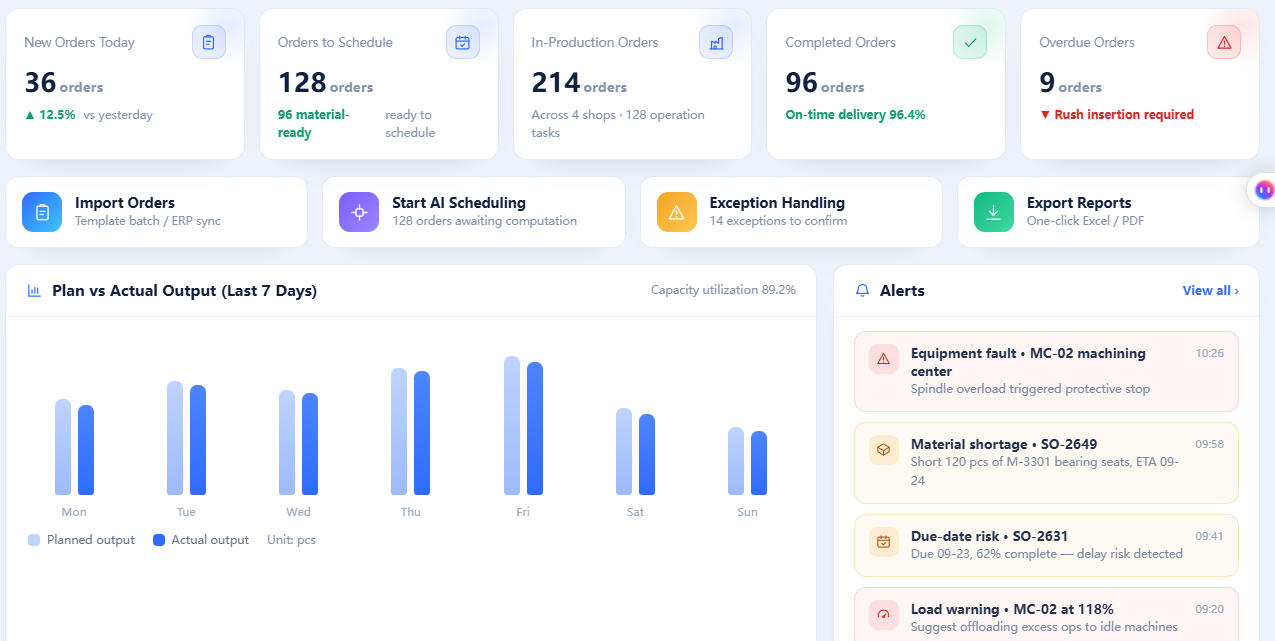
APS Production Scheduling System
1 System Overview 1.1 System Introduction The APS (Advanced Planning and Scheduling) system is a core digital system for the production operations of manufacturing enterprises. Built on the basis of finite capacity, it comprehensively considers multiple constraints such as orders, materials, equipment, personnel, processes, tooling and due dates, and generates scientific, executable production plans and scheduling solutions within minutes or even seconds. The system deeply integrates operations research optimization, artificial intelligence and industrial engineering methods, helping enterprises upgrade “production planning” from manual decision-making that relies on individual experience to data-driven, globally optimal intelligent decision-making. As a result, it significantly improves on-time delivery rates, equipment utilization and overall production efficiency, and serves as the key hub of the planning and management layer in a modern smart factory. The system can be deployed either as an independent advanced scheduling tool or deeply integrated with existing enterprise information systems such as ERP, MES, WMS and SCM, building an integrated closed loop covering sales forecasting, master production scheduling, material requirements, capacity scheduling, shop-floor execution and data feedback, helping enterprises realize lean production and digital transformation. 1.2 System Positioning and Value The system is positioned in the planning-management layer between “planning” and “execution”: upward, it receives sales orders, forecasts and demand plans from ERP; downward, it guides MES in shop-floor dispatching, process execution and on-site control. It is the key hub that connects the “Order–Planning–Execution–Feedback” closed loop. Its core value is reflected mainly in the following aspects: First, improving on-time delivery. Based on finite capacity and material-availability constraints, the system performs scheduling and provides committable due dates (ATP/CTP), avoiding “easy to accept orders but hard to deliver” and significantly reducing delayed deliveries. Second, lowering inventory levels. Through precise material requirements and production timing, it reduces work-in-process (WIP) accumulation and finished/semi-finished inventory occupancy, accelerating capital turnover. Third, improving resource utilization. It globally coordinates the loads of equipment, tooling and personnel, identifies and relieves bottleneck resources, and reduces equipment idleness and load imbalance. Fourth, enhancing responsiveness. Facing abnormalities such as order insertions, urgent orders, equipment failures and material shortages, the system can re-schedule within seconds and provide impact assessment to support rapid decision-making. Fifth, supporting multi-factory and supply chain collaboration. It coordinates capacity and supply rhythm across multiple bases, enabling nearest and optimal order allocation. Sixth, data visualization. It presents the overall production picture in an intuitive manner through Gantt charts, load charts and delivery-delay warnings, supporting transparent management. 1.3 Core Functional Modules 1.3.1 Order Management Supports aggregation, offsetting and merging of multi-source demand including sales orders, forecast orders, safety stock, finished-goods inventory and in-transit items. Combined with historical data and forecasting models, it generates time-phased demand to provide input for subsequent planning, and supports order prioritization, delivery commitment and change management. 1.3.2 Planning Management (MPS) Based on aggregated demand and available inventory, it generates the master production schedule under key resource constraints, determining how many end products to produce at what time, balancing demand and capacity, and providing a stable and feasible production framework for material requirements planning. 1.3.3 Material Management (MRP) Based on the master production schedule, bill of materials (BOM) and inventory/in-transit information, it explodes the required quantities and timing of materials at each level according to lead times, generating purchasing and in-house production plan recommendations to ensure material availability and timely supply. 1.3.4 Capacity Management It performs rough-cut capacity analysis for medium- and long-term plans, identifies capacity gaps and load peaks, supports the addition, reduction and balancing of resources such as equipment, production lines and personnel, and provides a basis for capacity investment and balanced production. 1.3.5 Finite Capacity Scheduling (FCS) Under the premise of finite capacity, it schedules each operation, each machine and each operator precisely down to day, shift or even minute. Taking into account due dates, priorities, changeover time, tooling and fixture constraints, and process constraints, it uses optimization algorithms to obtain a globally near-optimal solution, and serves as the core engine of the system. 1.3.6 Reporting Center It presents scheduling results through visual dashboards such as Gantt charts, load charts, bottleneck analysis charts and delivery-delay warnings, supporting planners in drag-and-drop adjustment, conflict detection, solution comparison and “What-if” simulation to intuitively grasp the overall shop-floor picture. 1.3.7 Production Execution Scheduling results can be issued to MES with one click or printed as dispatch orders. It collects execution data in real time such as completion, work reporting and equipment status, automatically compares the plan with actuals, triggers exception alerts for schedule deviations, material shortages and downtime, and supports exception-driven rapid re-scheduling. 1.3.8 Data Integration (ERP/MES/WMS) It provides standard interfaces and adapters to connect with mainstream ERP, MES, WMS and SCM systems, enabling automatic synchronization of data such as orders, materials, BOM, inventory, capacity and work reporting, ensuring data consistency between planning and execution. 2 APS Industries and Typical Application Scenarios The APS production scheduling system is widely applicable to manufacturing industries with complex scheduling constraints, multiple operations, multiple resources or due-date management requirements, especially suitable for discrete manufacturing, process manufacturing and the hybrid production modes of the two. The following selects typical industries including machinery equipment manufacturing, electronics and semiconductors, automotive and parts, food and beverage, pharmaceuticals and biopharmaceuticals, and printing and packaging. Combined with the production characteristics of each industry, typical application scenarios are introduced to explain how the APS system solves industry pain points and creates real value. 2.1 Machinery Equipment Manufacturing Machinery equipment manufacturing is dominated by discrete processing, with many operations, complex process routes and strong equipment versatility. It generally features high-mix low-volume production, order-driven manufacturing and frequent order insertions, placing high demands on the granularity and responsiveness of scheduling. 2.1.1 Application Scenario 1: High-Mix Low-Volume Discrete Production Scheduling Scenario background: Machinery equipment manufacturing enterprises generally face the production characteristics of “high-mix, low-volume, order-driven”. Order specifications are numerous, batch quantities are small, and process routes vary. The same workshop simultaneously handles multiple operations such as turning, milling, grinding, drilling, welding and assembly, with equipment and operators shared across operations. Manual scheduling that relies on the experience of planners is difficult to coordinate overall capacity comprehensively, easily resulting in an imbalanced situation of “some equipment overloaded in queues while other equipment idles”. When order insertions and urgent orders are frequent, scheduling plans are adjusted repeatedly, production preparation time is heavily occupied, and delivery commitments often diverge significantly from actual delivery. System application process: After the system goes live, the enterprise imports all basic data such as in-process orders, finished and semi-finished inventory, equipment ledgers, personnel skills and process routes into the system, automatically expanding demand through MPS and MRP to form production tasks for each operation. With “finite capacity” as the constraint, the APS scheduling engine comprehensively considers factors such as order due dates, material availability, equipment availability windows, tooling and fixtures, and personnel shifts, uses optimization algorithms to generate a globally near-optimal scheduling solution within minutes, and presents the task arrangement of each machine through visual Gantt charts. When order insertions, urgent orders or equipment failures occur, planners can adjust tasks in the system, which evaluates the impact on due dates and capacity occupancy in real time and automatically provides re-scheduling recommendations. After confirmation, the scheduling results are issued to MES with one click, and the shop floor executes according to system instructions, feeding progress back in real time through work reporting, forming a closed loop of “Plan–Execution–Feedback–Adjustment”, significantly improving machine utilization and on-time delivery rates. 2.1.2 Application Scenario 2: Assembly and Material-Availability Scheduling for Large Equipment Scenario background: The assembly of large equipment (such as machine tools, construction machinery and complete equipment sets) involves complex operations and long cycles, and involves material-availability (kitting) issues for a large number of purchased parts and self-manufactured parts. A shortage or delay of any key material or component can cause the entire assembly line to stop and wait for materials, resulting in serious schedule delays and resource waste. Meanwhile, scarce resources such as assembly sites, lifting equipment and specialized assembly personnel need to be reasonably allocated among multiple orders. How to ensure material kitting and the orderly connection of assembly resources is a common challenge for enterprises. In addition, demands for key resources from different orders often overlap in time, making it difficult for planners to coordinate the overall picture based on experience alone, and easy to attend to one thing while losing sight of another. System application process: The APS system brings the complete BOM and assembly process of large equipment into unified management, backward-schedules the assembly plan based on order due dates, and expands the kitting requirements of components and materials forward in linkage. The system tracks the purchasing in-transit, inventory and in-house production progress of key materials in real time, identifies material-shortage risks in advance through kitting checks, and triggers alerts for purchase expediting or alternative solutions. In terms of assembly resource allocation, the system treats final assembly sites, key workstations, lifting equipment and assembly teams as constrained resources for finite capacity scheduling, reasonably arranging the assembly sequence of multiple large equipment items to avoid resource conflicts and idle time. When a deviation occurs at any stage, the system automatically recalculates the impact on the overall due date and provides adjustment recommendations, helping planners make rapid decisions and ensuring that large equipment is delivered on time. The system also provides kitting warning and delivery-risk dashboards, enabling management to grasp the progress of each project in real time and coordinate purchasing and production resources in a timely manner, forming a complete management closed loop from planning and execution to risk control, fundamentally reducing the risk of delayed delivery of large equipment. 2.1.3 Application Scenario 3: Machine Load Balancing and Bottleneck Scheduling in the Workshop Scenario background: Machining workshops have many equipment types with large differences in processing capability, and often have obvious bottleneck equipment, such as heat-treatment furnaces and large machining centers. Since bottleneck operations determine overall capacity, if a large number of tasks accumulate in front of bottleneck equipment while other equipment idles, overall capacity is wasted and delivery is delayed. Manual scheduling is difficult to accurately identify and optimize bottlenecks, and often can only respond passively. System application process: Through capacity analysis and bottleneck identification, the APS system automatically marks bottleneck resources in the workshop and arranges the production rhythm around the bottlenecks, balancing the task volume of upstream and downstream operations through a “push-pull” approach to avoid task accumulation or material interruption in front of bottleneck equipment. Taking load balancing as one of its objectives, the system reasonably allocates tasks among equipment based on due dates and processing efficiency, making the loads of similar equipment relatively balanced and reducing idleness and overload. When bottleneck equipment fails or capacity fluctuates, the system rapidly re-schedules and provides alternative equipment options and capacity adjustment recommendations, minimizing the impact on overall output. Through continuous load balancing and bottleneck scheduling, enterprises can significantly improve the capacity utilization of the entire workshop and shorten the manufacturing cycle. The load charts and bottleneck analysis reports provided by the system also offer objective data support for equipment investment, capacity planning and staffing, helping enterprises alleviate capacity bottlenecks at the source. At the same time, the system supports periodic output of bottleneck and load analysis results as a decision-making basis for production meetings and continuous improvement, continuously driving the improvement of workshop management. 2.2 Electronics and Semiconductors The electronics and semiconductor industry has many process stages, a fast production rhythm and large equipment investment, with extremely high requirements on capacity utilization, yield and due dates. The granularity of scheduling directly affects the competitiveness of enterprises. 2.2.1 Application Scenario 1: PCB/SMT Line Takt Optimization and Changeover Scheduling Scenario background: PCB (Printed Circuit Board) and SMT (Surface Mount Technology) production lines have expensive equipment and many lines, with frequent product model changeovers. Changeovers, material replacements and stencil changes between different models require long preparation times, directly affecting the effective output of production lines. If changeovers are arranged improperly, a large amount of capacity is wasted; if task allocation is uneven, some lines are queued while others idle. How to reduce changeover times and improve line utilization through reasonable batch merging and sequencing while meeting due dates is a key concern of the industry. System application process: The APS system incorporates equipment and process parameters such as SMT lines, placement machines, printers and reflow soldering machines into the model, and performs intelligent batch splitting and sequencing of orders with “reducing changeovers, balancing loads and meeting due dates” as scheduling objectives. The system automatically identifies orders of the same or similar models and merges them for production, arranging a reasonable changeover sequence to shorten the total material-replacement and setup time; at the same time, it allocates tasks in a balanced manner according to the capability and load of each line to avoid load imbalance among lines. On the visual dashboard of scheduling results, planners can intuitively view the task arrangement and changeover points of each line, make drag-and-drop adjustments and evaluate the impact on due dates. After the scheduling results are issued to MES, the shop floor changes over and produces according to system instructions, and feeds execution progress back through real-time data, achieving efficient line operation and rapid changeover, significantly improving equipment utilization and order delivery capability. Through continuous takt optimization and changeover management, enterprises can substantially reduce production preparation costs, shorten order delivery cycles and enhance market competitiveness. 2.2.2 Application Scenario 2: Capacity-Constrained Scheduling for Semiconductor Packaging and Testing Scenario background: The semiconductor packaging and testing stage involves numerous operations and complex equipment types, including grinding, dicing, die attach, wire bonding, molding, plating and testing, with large differences in process routes and equipment capabilities across products. Packaging and testing equipment is of high value and capacity is highly tight, so the scheduling of key equipment directly affects overall output and due dates. At the same time, the semiconductor industry has strict requirements on yield, batch traceability and clean environment, and scheduling needs to balance process constraints and production specifications, making it extremely complex. System application process: The APS system incorporates the equipment, capacity, process constraints and product batches of the entire packaging and testing process into a unified model, performs finite capacity scheduling around key bottleneck equipment, reasonably allocates the production timing of each product batch on different operations and equipment, and balances overall capacity. The system supports batch merging, error-proofing constraints, cleanroom constraints and equipment PM (Preventive Maintenance) time constraints, ensuring that scheduling complies with process specifications. In response to abnormalities such as urgent order insertions and equipment downtime, the system can rapidly re-schedule, evaluate the impact on due dates and capacity, and provide the optimal adjustment plan. At the same time, the system is linked with MES to obtain equipment status and completion data in real time, achieving two-way collaboration between scheduling and execution, helping packaging and testing enterprises maximize the utilization of expensive capacity and guarantee delivery commitments to key customers. The transparency and automation of scheduling also significantly reduce the workload of planners and improve the scientific rigor and timeliness of planning management. 2.3 Automotive and Parts The automotive and parts industry is characterized by large-scale, assembly-line, takt-based production and high requirements for supply chain collaboration. Both vehicle manufacturers and parts enterprises need to achieve efficient production scheduling under strict due dates and high quality requirements. 2.3.1 Application Scenario 1: Sequencing Optimization for Mixed-Model Production Lines at Vehicle Plants Scenario background: Modern vehicle plants generally adopt mixed-model production lines, producing multiple models and configurations of vehicles on the same assembly line simultaneously. This must satisfy both the personalized needs of customer orders and the stability and efficiency of production takt. The work-hour differences, material supply and workstation loads of different models on the assembly line vary, and improper sequencing can cause problems such as line-side material shortages, workstation bottlenecks and increased model-changeover time, leading to capacity loss and delivery delays. How to meet the due dates and priorities of orders without sacrificing efficiency is the core difficulty of vehicle scheduling. System application process: Based on the vehicle order pool and assembly-line constraints, the APS system performs intelligent optimization of the production sequence. The system integrates factors such as model work-hours, workstation loads, material kitting, color and configuration changeover costs, customer due dates and transportation plans to build a scheduling optimization model, generating the optimal vehicle sequence that both meets order requirements and takes into account the stability of the production line. The system performs kitting checks on line-side materials, warns of material-shortage risks in advance and links pull replenishment; it also balances the loads of key workstations to avoid local congestion. After the sequencing results are issued to MES and the pull system, line-side feeding and assembly proceed in sequence, and the plan is continuously calibrated through real-time feedback. The system can also link the sequencing results with transportation and shipment plans, optimizing the connection between vehicle completion and delivery, further compressing in-transit time and inventory and improving the efficiency of full-chain delivery. The generation and adjustment of sequencing plans are fully documented and traceable, facilitating review and continuous improvement by production management. Through mixed-model sequencing optimization, vehicle plants can maintain high-takt stable production while satisfying personalized needs, improving delivery efficiency and customer satisfaction. 2.3.2 Application Scenario 2: Multi-Operation Multi-Line Collaborative Scheduling for Parts Scenario background: Automotive parts enterprises have many product types, large batch quantities and strict due dates, and often need multiple workshops and production lines to collaborate on completing an order, involving operations such as stamping, machining, surface treatment, assembly and inspection. The loads of different lines affect one another, and imbalanced capacity or uncoordinated scheduling can lead to semi-finished goods accumulation and delivery delays. At the same time, parts enterprises have a wide variety of parts and frequent mold changes and line changeovers. How to coordinate among multiple lines to achieve balanced production and on-time delivery is a key management challenge. Facing increasingly strict delivery requirements and frequent demand fluctuations from OEMs, scheduling based on experience alone is no longer adequate. System application process: The APS system incorporates the equipment capacity and process constraints of all workshops and production lines into a unified model, performs integrated multi-operation multi-line scheduling of orders, and automatically plans the processing timing and quantities of each operation on each line, achieving collaborative linkage across workshops and lines. Through load analysis, the system identifies capacity weaknesses and balances task allocation across lines, reducing WIP accumulation and line idleness; through material kitting checks and mold resource constraints, it avoids stoppages caused by material shortages or untimely mold changes. When an OEM order is adjusted or a line experiences an abnormality, the system rapidly re-schedules and adjusts related operations in linkage, ensuring that the overall plan remains feasible. The load and progress dashboards provided by the system help management grasp the operating status of each line in real time, promptly warn and handle risks, and significantly improve the executability of plans and overall operational efficiency. Through integration with OEM supply chain systems, it achieves collaboration of order and delivery information, helping parts enterprises improve on-time delivery rates and internal operational efficiency. 2.3.3 Application Scenario 3: Pull-Based Replenishment and Kitting Scheduling in the Supply Chain Scenario background: In the automotive and parts supply chain, OEMs often use kanban or rolling demand plans to pull parts supply, with high requirements on arrival timing and kitting. Parts enterprises need to organize production and distribution in a timely manner according to the pull signals of OEMs, avoiding both stock-outs that stop lines and excessive inventory. Facing pull demands from multiple customers, multiple models and multiple products, traditional scheduling is difficult to precisely match the arrival rhythm, easily resulting in the problem of “items that should be supplied are not supplied, while items that should not be supplied accumulate”. System application process: The APS system connects with the demand plans of OEMs, automatically receives pull signals and rolling orders, and converts demand into production tasks and distribution plans for each line. The system schedules with pull logic, organizes production as needed and backward-schedules the production timing of each operation to ensure that finished goods are kitted and completed before the demand point; through safety stock and kitting monitoring, it identifies supply risks in advance and triggers replenishment warnings. The system simultaneously coordinates the priorities and delivery windows of multiple customers, optimizes the production and distribution sequence, and improves vehicle loading and distribution efficiency. Through precise matching of supply and demand rhythm, enterprises can significantly reduce urgent replenishment and stock-out losses, effectively lower inventory while guaranteeing the continuous production of OEMs, enhance the resilience and responsiveness of the supply chain, and improve the overall level of supply chain collaboration. The system also places the supply assurance of key customers under key monitoring, prioritizing important orders when risks arise, balancing delivery performance and customer satisfaction. 2.4 Food and Beverage The food and beverage industry belongs to process manufacturing, characterized by batch production, continuous production, high hygiene requirements and shelf-life sensitivity. Scheduling needs to balance line continuity, cleaning changeovers and freshness constraints. 2.4.1 Application Scenario 1: Continuous-Flow and Batch Production Scheduling Scenario background: The production lines of food and beverage enterprises are mostly continuous-flow or semi-continuous-flow production, with high equipment start-up/shutdown and cleaning costs, and changeovers between different products often require preparation times such as cleaning and disinfection. If scheduling is improper, frequent product changeovers occupy a large amount of production time and reduce capacity utilization; at the same time, the supply and inventory of raw materials and packaging materials need to match the production rhythm. In addition, the shelf life and procurement cycles of raw materials need to be closely linked with the production plan, making scheduling highly complex and difficult to coordinate manually. How to reasonably merge batches of similar products, reduce changeover times and maintain continuous and efficient line operation while meeting order due dates is an important topic for food and beverage enterprise scheduling. System application process: The APS system incorporates line equipment, capacity, cleaning rules and changeover times into the scheduling model, and optimizes the sequence of production batches with “reducing changeovers, balancing loads and meeting due dates” as objectives. The system merges batches of products with the same or similar formulations, reasonably arranges the production order of different products, coordinates the load allocation of each line, and avoids local overload or idling. At the same time, the system links the inventory and supply of raw materials and packaging materials to ensure that the production plan is consistent with material kitting and avoid line stoppages due to material shortages. Scheduling results are presented through a production plan dashboard, supporting planners in drag-and-drop adjustment and delivery-impact evaluation, and are issued for execution after confirmation. The capacity and load dashboards provided by the system help management intuitively grasp line operation and respond to demand fluctuations and plan adjustments in a timely manner. Through continuous-flow and batch-optimized scheduling, enterprises can significantly improve line utilization, reduce cleaning and changeover costs, and ensure on-time order delivery. 2.4.2 Application Scenario 2: Order Scheduling under Shelf-Life Constraints and FIFO Scenario background: Food and beverage products have short shelf lives and high freshness requirements, so production and inventory management must strictly follow the First-In-First-Out (FIFO) principle to avoid losses caused by product expiration. In order scheduling, it is necessary to comprehensively consider raw material freshness, production dates, shelf life, warehouse turnover and customer requirements for freshness, and reasonably arrange the production sequence and quantities so that products are delivered to customers in the best condition. If scheduling does not consider shelf-life constraints, problems such as some product inventory accumulating and expiring, or some orders failing to meet freshness requirements, may occur. System application process: The APS system introduces shelf-life and FIFO constraints into the scheduling model, and intelligently plans the production timing and quantities of each order by integrating raw material batches, production dates, finished-goods shelf life and order requirements. According to the FIFO principle, the system preferentially consumes the earliest batches of raw materials and inventory, and reasonably arranges the production plan so that finished-goods inventory maintains reasonable turnover; at the same time, combined with warehouse capacity and turnover speed, it avoids overproduction causing accumulation. For the shelf-life and freshness requirements of different customers, the system optimizes scheduling on the basis of meeting due dates, prioritizing the early production of freshness-sensitive orders. The system also supports linked warnings for near-expiry inventory and orders, further safeguarding product freshness and sales safety. Through intelligent scheduling under shelf-life constraints, enterprises can effectively reduce expiration losses, ensure product quality and customer satisfaction, and improve inventory turnover efficiency. 2.5 Pharmaceuticals and Biopharmaceuticals The pharmaceutical and biopharmaceutical industry is strictly constrained by GMP regulations, with extremely high requirements on production batches, equipment cleaning, validation and traceability. Scheduling must balance compliance, safety and efficiency. 2.5.1 Application Scenario 1: Batch Production Records and GMP-Compliant Scheduling Scenario background: Pharmaceutical manufacturers must strictly comply with GMP (Good Manufacturing Practice). The production of each batch must follow established batch production instructions and process regulations, and the relevant records must be complete and traceable. Production scheduling must ensure that elements such as batch production instructions, batch records, and equipment and personnel qualifications meet regulatory requirements, avoiding quality risks and inspection deficiencies caused by conflicts between scheduling and compliance requirements. At the same time, pharmaceutical production has long cycles and strict batch management, and the collaborative scheduling of multiple products and batches places high demands on planning capability. Any omission at the planning level may lead to compliance risks and economic losses, so scheduling must be rigorous and reliable. System application process: The APS system embeds GMP compliance constraints in scheduling, incorporating batch production instructions, process regulations, equipment qualifications, personnel qualifications and validation status into scheduling validation conditions, ensuring that only qualified equipment and personnel are scheduled into production tasks. The system organizes batch production plans according to batch-number specifications and generates the planning information required for batch production records in linkage, ensuring complete batch traceability. The system optimizes the production timing of each batch, coordinates the production rhythm and material supply of multiple products, and ensures production by batch and by quantity, avoiding compliance conflicts. When process changes or validation status changes occur, the system promptly prompts and re-validates the feasibility of scheduling. Through the integration of scheduling and compliance management, pharmaceutical enterprises ensure quality and regulatory requirements while improving the scientific rigor and execution efficiency of production planning, effectively supporting compliant and efficient pharmaceutical production. The scheduling and batch information generated by the system can also directly interface with batch record systems, reducing manual transcription errors and improving data consistency. 2.5.2 Application Scenario 2: Equipment Cleaning and Changeover Time-Constrained Scheduling Scenario background: Pharmaceutical and biopharmaceutical production has extremely strict control of cross-contamination. Changeovers between different products and batches usually require strict equipment cleaning, disinfection and even validation, and the cleaning and validation time sometimes approaches or even exceeds production time, making it a key factor affecting capacity. If cleaning is arranged improperly, it can cause equipment idle waste or product quality risks. How to coordinate cleaning, disinfection, validation time and production tasks to maximize capacity utilization is an important difficulty in pharmaceutical scheduling. System application process: The APS system treats equipment cleaning, disinfection and validation time as mandatory scheduling constraints. Based on product compatibility rules, it automatically plans a reasonable production and cleaning sequence to minimize invalid downtime caused by product changeovers. The system prioritizes scheduling for equipment requiring long cleaning cycles, reduces cleaning times through batch merging of similar products, and reasonably arranges the connection between cleaning validation and other production tasks to improve overall equipment utilization. At the same time, the system tracks equipment status in real time and restricts the scheduling of tasks onto equipment when cleaning or validation is not completed, ensuring compliance. Scheduling results are linked with the equipment status dashboard, helping workshops reasonably arrange cleaning and production rhythm. Through intelligent scheduling under cleaning and changeover constraints, pharmaceutical enterprises can significantly improve the utilization and overall capacity of expensive production equipment while strictly meeting GMP requirements. Through the coordinated optimization of cleaning validation time and production tasks, enterprises can effectively release capacity and shorten product delivery cycles. 2.6 Printing and Packaging The printing and packaging industry has many order types, diverse colors and specifications, and frequent plate and color changes. Printing and downstream processes are tightly connected, with high requirements on imposition, color management and delivery control. 2.6.1 Application Scenario 1: Multi-Order Imposition and Color Changeover Optimization Scenario background: Printing and packaging enterprises undertake a large number of orders with various specifications. Press plate changes, color adjustment and ink adjustment require long preparation times, and orders of different color groups and processes change over frequently. If each order is run separately on the machine, a large amount of plate-changing, color-adjustment time and material waste results; if imposition is improper, it affects printing quality and the connection of downstream operations such as die-cutting and lamination. The connection quality of these links directly affects the delivery quality and cost of orders, placing high demands on the experience of planners, and manual scheduling finds it difficult to balance efficiency and quality. How to reduce the number of plate and color changes and increase the output of printing presses through reasonable imposition and production sequencing is the key to improving the efficiency of printing enterprises. System application process: The APS system incorporates resources and process constraints such as printing presses, printing plates, inks and paper into the scheduling model, supports intelligent imposition and merging of orders based on factors such as paper specifications, color similarity and process consistency, and combines orders suitable for same-machine production into the same batch, reducing the number of plate and color changes. The system performs finite capacity scheduling for printing presses, reasonably arranges the order-of-run and load allocation of each order, and coordinates the connection between printing and downstream operations such as die-cutting, lamination and binding to avoid upstream accumulation or downstream waiting for materials. Scheduling results are presented through visual dashboards, where planners can view the task arrangement and plate-change points of printing presses, optimize and adjust, and then issue for execution. The imposition and scheduling dashboards provided by the system help planners intuitively grasp press tasks and plate-change points and make timely optimizations and adjustments. Through imposition and color changeover optimization, printing enterprises can significantly reduce setup and material waste, improve press utilization and delivery efficiency, and enhance market competitiveness. 2.6.2 Application Scenario 2: Load Balancing and Due-Date Scheduling for Offset/Flexographic Lines Scenario background: Printing and packaging enterprises often have multiple types of printing equipment simultaneously, such as offset, flexographic and digital printing. Different equipment is suitable for orders of different materials and processes, and there are load differences among production lines. Order due dates are strict, and urgent orders and order insertions are frequent. If scheduling is imbalanced, some lines may be overloaded while others idle, or urgent orders cannot be inserted in a timely manner, affecting customer delivery and satisfaction. In addition, the cost and quality differences among different printing processes are obvious, and whether orders are properly matched to production lines directly affects the cost control and delivery capability of the enterprise, making it difficult for manual scheduling to coordinate comprehensively. System application process: The APS system intelligently matches orders to the most suitable production lines according to the process capability of each printing device and the characteristics of orders, coordinates the load allocation of multiple lines such as offset, flexographic and digital printing, and achieves overall capacity balance. The system schedules with due dates as the core constraint, prioritizing urgent and important orders and responding rapidly to order insertions: when an urgent order appears, planners evaluate its impact on the existing plan in the system, and the system automatically provides the optimal insertion position and adjustment solution. The system links materials (paper, ink and plate materials) and the capacity of downstream operations to ensure that the production plan is executable. The scheduling dashboards and progress tracking provided by the system help enterprises achieve transparent management of the full process from order acceptance and scheduling to delivery, and promptly identify and handle progress risks. Through line load balancing and due-date scheduling, printing and packaging enterprises can improve overall capacity utilization and order response capability while guaranteeing due dates, enhance market competitiveness, and lay a solid foundation for undertaking more quality orders.
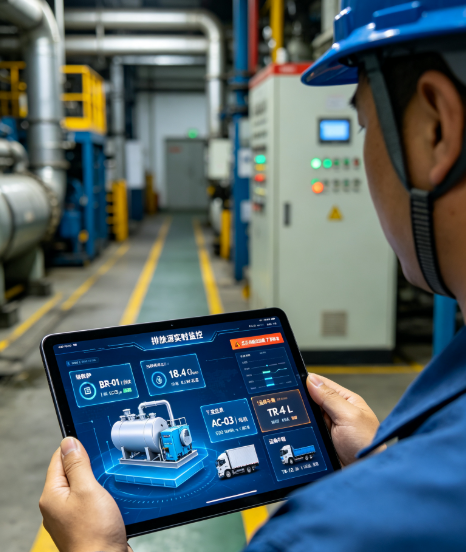
Carbon Emission Management Software
1. Software Overview 1.1 Software Introduction Carbon Emission Management Software is a professional energy and carbon management and control system designed for industrial enterprises, energy plants, and group enterprises. It has been developed in strict compliance with the Guidelines for Accounting Methods and Reporting of Corporate Greenhouse Gas Emissions and the compliance requirements of the national carbon market. The software delivers full-process digital management across automatic collection of enterprise energy consumption and carbon emission data, intelligent accounting, carbon asset management, emission reduction analysis, automated report generation, and compliance delivery. It meets business requirements including carbon verification, carbon market compliance, ESG disclosure, and enterprise energy-saving and carbon-reduction assessments, and is applicable to a wide range of energy and industrial scenarios such as thermal power, photovoltaic, energy storage, coal, chemical, and industrial parks. 1.2 Core Functions The software centers on six core modules: data collection management, greenhouse gas MRV (Measurement, Reporting and Verification) accounting, carbon asset compliance management, emission reduction data analysis, compliance report output, and system permission control. It supports multi-level, hierarchical management across group, subsidiary, plant, and unit, enabling carbon emission data to be monitored, reported, and verified. 1.3 Operating Environment Client side: Windows 10/11, macOS and later; compatible with Chrome, Edge, and 360 Extreme Explorer (latest versions). Server side: supports on-premises deployment and cloud SaaS deployment; compatible with domestic Xinchuang servers and databases. Network requirements: enterprise intranet or public network environment, ensuring connectivity with plant DCS, SCADA, CEMS, energy metering devices, and enterprise ERP and MES systems. 2. Login and Initial Setup 2.1 System Login Open a browser, enter the access address of the software system, and go to the system login page. Enter the account and password assigned by the enterprise, complete the slider verification, and click [Login]. On first login, changing the initial password is mandatory. It is recommended that the password be a combination of letters, numbers, and special symbols to enhance account security. 2.2 Basic Information Initialization (Administrator Operations) Basic configuration must be completed before the system is first used, providing the foundation for subsequent carbon accounting and data statistics: Organizational structure configuration: go to [System Settings] - [Organization Management], enter hierarchical information such as group, subsidiary, plant, and production unit to build the enterprise organizational structure tree. Emission boundary configuration: go to [Carbon Basic Settings] - [Emission Boundary Management], add emission units based on the enterprise operating boundary, and bind production equipment and energy consumption points. Factor library configuration: the system is pre-loaded with official national accounting factors and IPCC factors by default; administrators can customize calorific values and emission factors based on the enterprise's measured data. User permission assignment: go to [User Management] to add regular user, verification user, and administrator accounts, and assign differentiated permissions such as data reporting, accounting review, and report export. 3. Core Functionality Operations Guide 3.1 Data Collection and Reporting Management This module forms the foundation of carbon accounting and is responsible for collecting raw data on enterprise energy consumption, fuel, and carbon emissions, supporting both automatic collection and manual reporting. 3.1.1 Automatic Data Collection The system automatically connects to plant smart electricity meters, gas meters, CEMS flue gas monitoring systems, DCS/SCADA production systems, and ERP fuel storage systems, and automatically captures the following data: purchased electricity/heat consumption, coal/natural gas/fuel oil consumption, real-time flue gas carbon emission data, and production operation data. Collected data is automatically stored in the system with full audit trails and requires no manual intervention. 3.1.2 Manual Data Reporting For scenarios without automatic collection devices, manual reporting of Scope 1/Scope 2/Scope 3 related data is supported: Go to [Data Management] - [Manual Reporting], and select the reporting plant and reporting period (day/month/quarter/year). Enter data such as fuel consumption, vehicle fuel usage, employee business travel, and raw material transport, and upload supporting attachments such as weighbridge tickets, invoices, and test reports. After submission, data awaits administrator review; once approved, the data takes effect and is included in carbon accounting statistics. 3.1.3 Data Validation and Anomaly Handling The system automatically validates collected and reported data, and issues automatic alerts for missing data, abnormal values, and excessive year-on-year or period-over-period fluctuations. Users can enter the [Data Alerts] module to view the anomaly list, verify and correct the data, and record reasons, ensuring the authenticity and compliance of data. 3.2 Greenhouse Gas (GHG) MRV Accounting Management As the core function of the system, this module automatically completes comprehensive carbon emission accounting for the enterprise and meets the MRV compliance requirements of carbon verification. 3.2.1 Accounting Scope Scope 1 (direct emissions): accounts for carbon emissions from combustion by the enterprise's own equipment, production processes, and equipment fugitive emissions. Scope 2 (indirect emissions): accounts for indirect carbon emissions from purchased electricity and heat. Scope 3 (other indirect emissions): optionally accounts for whole-chain carbon emissions including raw material transport, product distribution, employee business travel, and waste treatment. 3.2.2 Automatic Accounting Operations Go to [Carbon Accounting] - [GHG Accounting], and select the accounting entity and accounting period. Click [One-click Accounting], and the system automatically applies official accounting formulas and the factor library to complete the calculation of total carbon emissions and emission intensity. After accounting is completed, detailed data can be viewed, including activity data, factor parameters, calculation processes, and final emission amounts. 3.2.3 Export of Accounting Working Papers After accounting is completed, the system supports one-click export of the complete set of carbon verification working papers, including the fuel ledger, energy consumption ledger, emission calculation sheets, and data traceability records, which can be directly used for third-party carbon verification and data reporting to the Ministry of Ecology and Environment. 3.3 Carbon Asset and Compliance Management (for Emission-Controlled Enterprises) For emission-controlled enterprises included in the national carbon market, the system enables full-process digital management of carbon allowances, CCER (China Certified Emission Reduction), and annual compliance. 3.3.1 Carbon Allowance Ledger Management Go to [Carbon Asset Control] - [Allowance Management] to enter annual free allowances and auctioned allowance data. The system automatically calculates allowance holdings, amounts used, and remaining balances, and displays the enterprise's allowance surplus/deficit status in real time. 3.3.2 CCER Project Management The system supports entering information on emission reduction projects such as photovoltaic, wind power, and forestry carbon sinks, registering CCER emission reduction volumes, validity periods, and offset ratios, and automatically calculating the emission reduction credits available for compliance. 3.3.3 Annual Compliance and Alerts Based on annual carbon emission data, the system automatically calculates the allowances required for compliance and issues pop-up alerts for situations such as allowance deficits and approaching compliance deadlines. Users can simulate compliance plans online, calculate the cost differences between CCER offsetting and allowance procurement, and complete the online compliance process registration. 3.4 Data Analysis and Emission Reduction Simulation 3.4.1 Visual Data Dashboard The system homepage integrates a carbon and energy big data dashboard that displays in real time the enterprise's total carbon emissions, carbon emission intensity per unit of output, emission share by plant/equipment, historical emission trends, and energy-carbon benchmarking data, intuitively presenting the enterprise's current decarbonization status. 3.4.2 Emission Reduction Scenario Simulation In the [Emission Reduction Analysis] module, multiple decarbonization options can be simulated: purchasing green electricity, fuel substitution, equipment energy-saving retrofitting, and CCUS carbon capture retrofits. The system automatically calculates the emission reduction volumes, decarbonization costs, and return on investment for different options, providing data support for the enterprise's decarbonization decisions. 3.4.3 Indicator Assessment Decomposition Administrators can enter the enterprise's annual decarbonization targets. The system automatically decomposes the total carbon emission and intensity indicators to each subsidiary and plant, tracks target completion rates in real time, and supports the export of performance assessment data. 3.5 Compliance Reporting and Disclosure Management The system supports one-click generation of various compliance reports, addressing the cumbersome manual report compilation and data accuracy issues: Annual carbon emission report: adapted to the national carbon market reporting format and directly usable for filing on the Ministry of Ecology and Environment platform. Carbon inventory report: automatically generates a comprehensive annual enterprise carbon inventory report, including accounting boundaries, data sources, accounting results, and emission reduction recommendations. ESG/TCFD disclosure reports: outputs ESG sustainability reports and carbon information disclosure materials adapted for listed companies and group enterprises. Custom reports: supports user-defined filter conditions to export monthly and quarterly energy consumption and carbon emission statistics reports.

AI Computing Power Construction Service
1 System Overview With the rapid iteration of artificial intelligence, big data, and deep learning technologies, AI computing power has become the core infrastructure for digital and intelligent transformation across all industries, and serves as the fundamental support for model training, intelligent inference, data analysis, and intelligent decision-making. We provide one-stop AI computing cluster construction services, building dedicated AI computing foundations for enterprises and research institutions. Our services fully support the deployment of AI businesses such as large-model pre-training, parameter fine-tuning, intelligent inference, and multimodal generation, enabling you to launch AI projects quickly without having to delve into the underlying infrastructure. We will tailor computing solutions based on your business objectives, model parameter scale, dataset size, and data security requirements. For large-model training scenarios, we prioritize high-bandwidth multi-GPU clusters; for business inference scenarios, we optimize node configuration to control latency and energy consumption, finding the optimal balance between performance and cost. From hardware selection and procurement, computer room supporting renovation, and equipment racking and cabling, to high-speed RDMA network deployment and parallel storage setup, the entire process is implemented by our professional technical team. On the software side, we complete the deployment of the operating system, CUDA drivers, and container environments, build Kubernetes clusters and distributed training frameworks, and launch computing scheduling platforms, model repositories, and resource monitoring and alerting systems. After completing full-cluster joint debugging and testing, we deliver an environment that can run AI tasks directly. The service offers two deployment models: local private deployment and co-location managed clusters. With private deployment, data remains within the customer's own environment, meeting classified and high-security business requirements; the managed hosting option can significantly shorten the construction cycle and reduce the early-stage investment in computer room supporting facilities. After project delivery, our company provides 7×24 operation and maintenance support, including hardware inspection, environment and version upgrades, rapid fault handling, and system security hardening, as well as supporting subsequent elastic expansion of computing capacity. We provide a one-stop solution for AI computing infrastructure, saving you the high costs and trial-and-error risks of building an underlying technical team yourself, helping your AI innovation projects land quickly and seize the digital transformation opportunity in your industry. 2 Core Industries Suitable for AI Computing Construction As the core foundation of intelligent transformation, AI computing power is broadly applicable to multiple industries, including industrial manufacturing, financial services, energy and mining, smart security, healthcare, retail and commerce, education and research, and emergency firefighting. By relying on dedicated computing platforms, each industry can achieve large-scale deployment of AI technologies, empowering industries to improve quality and efficiency, reduce costs and risks, and achieve intelligent upgrading. 2.1 Industrial Manufacturing Traditional manufacturing faces challenges such as low production efficiency, large errors in manual quality inspection, frequent equipment failures, chaotic production scheduling, and severe energy waste. Through dedicated AI computing construction services, industrial intelligent computing clusters can be built to support the deployment of AI applications such as machine vision inspection, intelligent scheduling, equipment predictive maintenance, and production energy optimization. This achieves intelligent management and control of the entire production process, helping traditional factories transform into smart factories. 2.1.1 AI Visual Intelligent Quality Inspection for Industrial Products Background: Traditional industrial product quality inspection generally relies on manual visual inspection. For categories such as precision components, electronic products, hardware products, and textile products, there are problems including low inspection efficiency, large errors from human fatigue, high miss rates for subtle defects, and inconsistent inspection standards. Small and medium-sized manufacturing enterprises may inspect tens of thousands of products per day; manual inspection not only requires substantial labor costs but also cannot accurately identify subtle defects such as scratches, dents, color differences, micro-cracks, and dimensional deviations, easily allowing non-conforming products to reach the market and causing after-sales disputes and brand damage. Meanwhile, manual inspection data cannot be accumulated and analyzed, making it difficult to optimize production processes. As manufacturing becomes more precise and standardized, industry requirements for inspection accuracy, efficiency, and stability have risen significantly, and traditional manual inspection can no longer meet production needs. There is an urgent need to rely on AI computing power to support the deployment of machine vision intelligent inspection systems, achieving fully automated, high-precision, and uninterrupted inspection. Equipment application and computing deployment process: Our company builds a dedicated edge + cloud hybrid AI computing platform for manufacturing enterprises. High-definition industrial cameras and image acquisition equipment are deployed at the front end to collect high-definition image data from the production line in real time. Edge computing nodes handle real-time image pre-processing and preliminary defect identification, while cloud computing clusters carry out deep learning model training, precise defect determination, and data aggregation and analysis. First, relying on the high-performance computing cluster, dedicated industrial inspection AI models are trained based on the enterprise's massive historical inspection data and product defect sample data. Through the high-speed iterative capability of computing power, model recognition accuracy is continuously optimized to adapt to the recognition needs of different products and defect types. During production, when products on the line pass through inspection stations, industrial cameras capture all-round product images within milliseconds and transmit them to edge computing devices, which perform real-time denoising, cropping, and feature extraction, quickly compare against the model database, and accurately determine whether a product has defects, locate defect positions, and distinguish defect types. For routine defects, the edge computing layer directly completes determination and issues sorting instructions; for subtle and difficult defects, they are uploaded to the cloud computing cluster for secondary precise analysis and determination, ensuring zero missed detections and zero false detections. At the same time, the computing platform accumulates all inspection data in real time, automatically counts defect types, defect probabilities, and high-frequency defect stations, providing data support for production process optimization. Value: Once this computing solution is deployed, it enables 24-hour uninterrupted intelligent inspection of the production line, with inspection efficiency improved by more than 10 times compared to manual inspection and product defect recognition accuracy reaching 99.8%, thoroughly eliminating missed detections and false detections caused by human fatigue. Through inspection data analysis, production processes can be optimized in reverse, reducing product defect rates and improving product qualification rates and market competitiveness, helping enterprises achieve intelligent upgrading of the production stage. 2.1.2 Predictive Intelligent Maintenance of Industrial Equipment Background: Industrial production lines contain a large number of precision production equipment such as machine tools, conveyor belts, air compressors, and robots. The traditional equipment maintenance model is “scheduled maintenance + breakdown repair”. Scheduled maintenance has problems of over-maintenance and untimely maintenance, wasting labor and resources; breakdown repair is often carried out after equipment shutdown failures, directly causing production line stoppages, capacity loss, and order delays, seriously affecting enterprise production efficiency. Under the traditional model, equipment operating status cannot be monitored in real time and potential failures cannot be predicted; subtle abnormal data such as equipment vibration, temperature, speed, and noise are difficult to capture and analyze accurately, and small hidden problems accumulated over time can easily trigger major equipment failures, increasing maintenance costs and downtime losses. In the current context of smart manufacturing, enterprises urgently need intelligent means to achieve early prediction and precise maintenance of equipment failures and ensure stable production line operation, which requires high-performance AI computing power to support real-time analysis of equipment data and intelligent prediction. Equipment application and computing deployment process: Our company builds a distributed AI computing cluster for the enterprise, adapted to the real-time processing of massive time-series data from industrial equipment and AI model inference requirements. First, IoT sensors for temperature, vibration, speed, current, and noise are deployed on various production equipment to collect all-dimensional equipment operating data around the clock, with data transmitted in real time to the dedicated computing platform. Relying on the high-speed computing capability of the cluster, equipment failure prediction AI models are run to clean, analyze, and extract features from massive real-time data, accurately identify abnormal equipment operating characteristics, compare against historical failure data models, and predict potential equipment failure types, failure occurrence times, and the scope of failure impact. Based on prediction results, the computing platform automatically generates optimal maintenance plans, precisely informing staff of fault locations, maintenance methods, and maintenance cycles, while intelligently assessing equipment operating wear and component aging levels. For minor equipment abnormalities, the platform automatically issues warnings to remind staff to conduct timely investigation; for high-risk potential failures, it directly triggers emergency alerts and links with production line control systems to implement protective measures, avoiding sudden shutdowns. At the same time, the computing platform continuously accumulates equipment operating and maintenance data, iteratively optimizes prediction models, and continuously improves the accuracy of failure prediction. Scenario value: By empowering equipment predictive maintenance with AI computing power, the traditional passive maintenance model is thoroughly transformed, achieving early prediction and precise maintenance of equipment failures, with the sudden equipment shutdown failure rate reduced by more than 90%, greatly reducing production line stoppage losses. Precise maintenance plans avoid resource waste caused by over-maintenance, reduce equipment maintenance costs and component wear, and extend equipment service life. Meanwhile, the computing platform realizes visualized and intelligent management of equipment operation and maintenance data, helping enterprises establish standardized equipment operation and maintenance systems, ensuring efficient, stable, and continuous production line operation, and effectively improving enterprise capacity and production stability. 2.2 Financial Services The financial industry covers sub-fields such as banking, insurance, securities, and internet finance, characterized by large data volumes, high real-time requirements, strict risk control, and strong compliance requirements. Traditional financial businesses face pain points including low credit review efficiency, many risk control loopholes, poor fraud identification accuracy, lagging customer service, and low data analysis efficiency. AI computing construction can support the deployment of AI applications such as intelligent financial risk control, intelligent credit review, intelligent investment advisory, financial data analysis, and intelligent customer service, helping financial institutions achieve business intelligence, refined risk control, and efficient service upgrading. 2.2.1 Intelligent Credit Review and Risk Control for Financial Lending Background: Traditional credit review models of banks, rural credit cooperatives, and small loan institutions are mainly manual. Reviewers must check one by one massive amounts of customer credit information, income proof, asset information, transaction statements, credit reports, and other materials. The review process is cumbersome and time-consuming, with a single credit review taking as long as 1–3 working days, resulting in a poor customer experience. At the same time, manual review relies on staff experience and has relatively large subjective judgment errors, making it difficult to accurately identify hidden credit risks and prone to malicious fraud lending, overdue bad debts, and other problems that cause financial losses for institutions. In addition, the traditional review model cannot perform batch analysis of massive customer data, making it difficult to adapt to the batch credit business needs of inclusive finance, and business expansion efficiency is extremely low. As financial digital transformation accelerates, the industry urgently needs to build intelligent review systems based on AI computing power to achieve automated credit review, precise risk determination, and efficient business processing. Equipment application and computing deployment process: Our company builds a localized dedicated AI computing cluster for financial institutions, balancing computing performance with data security and compliance, avoiding public cloud data leakage risks and high computing cost consumption. The computing platform connects to the financial institution's core business systems, credit systems, and transaction systems, and can capture multidimensional massive data such as customer basic information, credit data, capital flows, consumption behavior, and repayment records in real time. Relying on high-performance computing resources, financial credit risk control large models are run to clean, model, analyze, and rate all customer-dimension data within milliseconds, quickly building customer credit profiles. In the review stage, the computing platform automatically verifies the authenticity of customer materials, identifies problems such as material fraud and abnormal information, accurately determines customer credit ratings, credit limits, and overdue risks, and automatically generates review results and risk control reports. For ordinary small-amount credit business, fully automated review can be achieved with results produced within seconds; for large-amount credit business, intelligent preliminary review is completed, providing precise data support for manual re-review and greatly simplifying the review process. At the same time, the computing platform can iterate risk control models in real time, optimizing algorithms in combination with the latest credit cases, fraud methods, and overdue data, continuously improving risk identification accuracy and avoiding new credit risks. Value: The intelligent credit review system empowered by computing power compresses the traditional multi-day review cycle to 1–2 minutes, improving review efficiency by more than 100 times, greatly optimizing the customer experience and helping financial institutions increase business volume and market competitiveness. Intelligent risk control models raise credit risk identification accuracy from 70% under the traditional approach to more than 95%, greatly reducing fraud lending, overdue, and bad debt risks and reducing capital losses. Localized computing deployment fully meets financial data compliance requirements, safeguarding customer financial data security, while batch processing capability can support inclusive finance batch credit business, helping financial institutions efficiently expand into lower-tier markets and achieve business growth. 2.2.2 Intelligent Risk Control and Anti-Fraud Identification for Financial Transactions Background: At present, online financial transactions, transfers, and payment businesses continue to surge in scale, and financial risks such as telecom fraud, money laundering, false transactions, and abnormal cash-out are emerging one after another, with increasingly concealed and complex fraud methods. Traditional financial risk control systems rely on fixed rule-based determination and can only identify routine abnormal transactions, unable to accurately identify new and concealed fraudulent transactions, leaving numerous risk control loopholes. Meanwhile, financial transactions feature high concurrency and high real-time requirements, with daily transaction data reaching billions of records. Traditional computing equipment cannot achieve real-time monitoring, analysis, and alerting of massive transaction data; abnormal transaction detection lags behind, and problems can often only be traced after capital loss, making it impossible to intercept risks in advance and causing irreversible capital losses for users and financial institutions. There is an urgent need for high-performance AI computing power to support real-time intelligent risk control systems, achieving real-time identification, precise interception, and early warning of transaction risks. Equipment application and computing deployment process: Our company builds a financial-exclusive AI computing cluster with high concurrency and low latency, adapted to millisecond-level real-time processing of financial transactions and supporting synchronized analysis and processing of hundreds of thousands of transaction records per second. The computing platform connects in real time to payment transaction systems and user account systems, dynamically capturing all-dimensional data of each transaction including transaction time, transaction amount, transaction location, device information, transaction frequency, counterparty accounts, and user behavior habits. Relying on the high-speed inference capability of computing power, AI models for financial anti-fraud and abnormal transaction identification are run to compare in real time against user historical transaction behavior and routine transaction habits, accurately identifying risk scenarios such as abnormal cross-region transfers, high-frequency small-amount cash-out, unfamiliar large-amount transactions, abnormal nighttime transactions, and suspected money-laundering diversion transactions. Once a risky transaction is identified, the computing platform immediately triggers alerts, automatically intercepts the transaction and freezes abnormal accounts, and pushes risk information to risk control staff simultaneously. At the same time, the computing cluster continuously learns the latest fraud cases and abnormal transaction patterns, dynamically iterates model algorithms, and adapts to new financial fraud methods, filling the loopholes of traditional rule-based risk control. In addition, the platform can conduct batch post-review analysis of daily transaction data, summarize risk transaction characteristics, and output risk control optimization reports, helping financial institutions improve their risk control systems. Value: This computing solution achieves full-volume, real-time, intelligent risk control of financial transactions, with abnormal transaction identification response speed reaching the millisecond level and a risk interception success rate improved by 98%, effectively curbing various financial risks such as telecom fraud, money laundering, and cash-out, and safeguarding user capital security and financial institution operational security. High-concurrency computing supports the system in smoothly handling transaction peaks and holiday peak traffic without jamming, delay, or crashes, ensuring stable operation of financial businesses. At the same time, intelligent risk control greatly reduces manual risk control workload, lowers risk control labor costs, and improves the refinement and intelligence level of financial institution risk control. 2.3 Energy and Mining The energy and mining industry includes sub-fields such as coal mining, oil and gas, electric power, and new energy. Its operating scenarios are complex, with harsh environments, high safety risks, and difficult operation and maintenance. Traditional operating models face pain points such as low inspection efficiency, untimely hidden danger investigation, high production energy consumption, and high equipment failure rates. AI computing construction can support the deployment of scenarios such as intelligent mine inspection, hidden danger identification, intelligent oil and gas extraction, intelligent grid dispatching, and new energy power forecasting, empowering the energy and mining industry to achieve safe production, cost reduction and efficiency improvement, and intelligent upgrading. 2.3.1 Intelligent Safety Inspection and Hidden Danger Identification in Underground Coal Mines Background: Traditional underground coal mine inspection relies on manual underground operations. Underground environments involve multiple safety hazards such as gas leakage, roof collapse, water accumulation and sludge, foreign objects blocking roadways, and equipment failures. Manual inspection carries extremely high risks, and with complex underground roadways and wide inspection coverage, manual inspection is time-consuming and inefficient, making it difficult to achieve full-area, all-round, no-blind-spot inspection. At the same time, manual inspection suffers from high subjectivity and high miss rates; subtle abnormal gas concentrations, equipment aging, and roadway cracks cannot be detected in time, and accumulated over time can easily trigger major safety accidents, seriously threatening the lives of underground workers and the safety of mine production. In addition, manual inspection data cannot be aggregated and analyzed in real time, making it difficult to achieve early prediction and precise treatment of hidden dangers. There is an urgent need to rely on AI computing power to build an underground intelligent inspection system that replaces manual work for high-risk inspection tasks. Equipment application and computing deployment process: Our company builds a mining-exclusive AI computing cluster for mining enterprises, adapted to data transmission and AI identification needs in complex underground environments while balancing explosion-proof, stability, and low-power characteristics. The project deploys underground explosion-proof cameras, inspection robots, gas sensors, temperature sensors, and other equipment to comprehensively collect data such as underground roadway images, gas concentrations, ambient temperatures, and equipment operating status, transmitted through dedicated mine networks in real time to the surface AI computing platform. The computing cluster is equipped with mine-exclusive intelligent identification large models. Relying on powerful computing capability, it performs real-time analysis and processing of live images and sensor data, accurately identifying more than ten categories of hidden dangers such as coal accumulation, foreign objects on tracks, roof cracks, excessive gas, water and sludge accumulation, equipment abnormalities, and illegal operations. For routine hazards, the platform issues real-time pop-up alerts and voice broadcasts, pushing hazard locations and rectification suggestions; for high-risk hazards such as excessive gas and abnormal roofs, it immediately triggers emergency alerts, links with underground audible and visual alarm devices to remind workers to evacuate urgently, and links with equipment control systems to shut down related operating equipment. At the same time, the computing platform records inspection data continuously 24 hours a day, automatically counts high-incidence hazard areas and types, forms a hazard treatment ledger, provides data support for mine safety management, roadway rectification, and equipment maintenance, and continuously iterates and optimizes identification models to improve the accuracy of hidden danger investigation. Value: The intelligent inspection system empowered by AI computing power thoroughly replaces manual high-risk underground inspection operations, fundamentally reducing underground operation safety risks and eliminating safety accidents caused by manual inspection. 24-hour uninterrupted intelligent inspection achieves full-area, no-blind-spot hidden danger investigation underground, reducing the hidden danger miss rate to zero and improving hidden danger detection and handling efficiency by more than 90%, effectively avoiding major mine safety accidents. At the same time, the intelligent data ledger helps mines achieve standardized, refined, and intelligent safety management, reducing safety management costs and improving mine safety production levels and production efficiency. 2.3.2 Intelligent Inspection and Load Dispatching of Power Grids Background: Traditional power grid operation and maintenance relies on manual inspection and manual dispatching. Power grids include massive facilities such as transmission lines, substations, transformers, and distribution equipment, with wide coverage and scattered regional distribution, making inspection of mountain and field lines extremely difficult. Manual inspection is inefficient and time-consuming, and it is difficult to promptly detect problems such as line damage, insulator failures, equipment aging, and tree-related hazards, which can easily lead to line tripping and power outage accidents. At the same time, traditional grid load dispatching relies on manual experience for prediction and cannot precisely match load changes during power consumption peaks and valleys, resulting in insufficient supply redundancy, uneven load distribution, and energy waste, and making it difficult to adapt to the dynamic dispatching needs of power grids after new energy grid integration. There is an urgent need for AI computing power to support intelligent grid operation, maintenance, and dispatching. Equipment application and computing deployment process: Our company builds a low-latency, high-stability power-exclusive AI computing platform to support real-time analysis of massive grid equipment data and power consumption data and intelligent dispatching. At the front end, drones, high-definition cameras, and power sensing equipment collect all-dimensional data on operating images, temperature, current, and voltage of transmission lines, substations, and distribution equipment, uploaded in real time to the computing cluster. The computing platform runs power grid intelligent inspection AI models to automatically identify fault hazards such as line strand breakage, equipment damage, tree coverage, insulator contamination, and abnormal equipment heating, accurately locate fault points, assess fault levels, and automatically generate inspection reports and rectification plans. In terms of load dispatching, the computing platform aggregates grid-wide power consumption data, meteorological data, new energy power generation data, and historical power consumption peak data, and through big data analysis and AI algorithm modeling, accurately predicts regional power load change trends, dynamically optimizes grid load distribution strategies, and intelligently adjusts transmission, distribution, and supply power to achieve grid load balancing. Given the intermittent power generation characteristics of wind and photovoltaic new energy, the computing platform predicts generation power in real time, optimizes new energy grid integration dispatching plans, improves the new energy consumption rate, and ensures stable, efficient, and energy-saving grid power supply. Value: Computing-empowered intelligent grid operation and maintenance achieves automatic identification and early warning of grid equipment failures, with troubleshooting efficiency improved by more than 80%, greatly reducing the probability of grid fault tripping and power outages and improving power supply reliability. Intelligent load dispatching thoroughly solves the traditional problems of low manual dispatching accuracy and energy waste, greatly improving grid resource utilization and significantly enhancing new energy consumption capacity, effectively reducing grid operation energy consumption and operation and maintenance costs, and helping the new-type power system achieve intelligent and green upgrading. 2.4 Smart Retail The smart retail industry includes scenarios such as offline supermarkets, chain stores, and e-commerce platforms, with core pain points concentrated on lagging customer traffic analysis, chaotic inventory management, low marketing precision, and slow supply chain response. AI computing construction can support the deployment of AI applications such as intelligent customer traffic analysis, intelligent inventory management, precision marketing push, and intelligent supply chain forecasting, achieving intelligent management and control of the entire “people, goods, and places” chain, improving retail operation efficiency and revenue conversion. 2.4.1 Intelligent Customer Traffic Analysis and Precision Marketing for Supermarkets and Stores Background: Marketing and operations of traditional supermarkets and chain stores rely on manual experience and cannot precisely grasp core data such as store customer traffic patterns, customer consumption preferences, and product attention levels. Peak and valley periods of store customer traffic cannot be predicted accurately, leading to unreasonable staff scheduling and wasted service resources; consumption needs of different customer groups cannot be identified, marketing activities are carried out blindly, promotion investment costs are high, and conversion effects are poor; at the same time, data such as customer walking routes and product dwell time cannot be quantitatively analyzed, and store display layout optimization lacks data support, seriously affecting store operating efficiency and revenue conversion. Traditional data statistics can only achieve after-the-fact data aggregation and cannot achieve real-time analysis and dynamic optimization, so there is an urgent need for AI computing power to support real-time customer traffic sensing and intelligent marketing decisions. Equipment application and computing deployment process: Our company builds an edge + cloud collaborative AI computing system for retail enterprises, adapted to the lightweight, multi-node, real-time computing needs of stores. Smart cameras and customer traffic collection equipment are deployed at the front end of each store to collect in real time all-dimensional data such as store customer traffic volume, entry and exit time periods, customer walking routes, product dwell time, customer age and gender, and consumption behavior. Edge computing nodes complete real-time data desensitization, pre-processing, and preliminary analysis, while cloud computing clusters carry out big data aggregation, model training, trend forecasting, and marketing decision functions. Through AI visual analysis algorithms, the computing platform generates store customer traffic heatmaps and customer traffic time-distribution charts in real time, accurately identifies daily customer traffic peak and valley periods, and provides real-time data support for store staff scheduling and service allocation. At the same time, relying on massive customer traffic and consumption data, user profile models are trained to accurately analyze the consumption preferences, popular products, and consumption habits of different customer groups, automatically identifying slow-moving products and best-selling products in stores. Based on analysis results, the computing platform dynamically outputs store display optimization plans, promotional activity plans, and product combination plans, and links with store electronic price tags and intelligent push devices to achieve precise pricing and targeted promotions. In addition, the platform can aggregate data from national chain stores, complete predictions of overall customer traffic and consumption trends, and provide support for the formulation of overall corporate marketing strategies. Value: Computing-empowered real-time quantitative analysis of store customer traffic and consumption data thoroughly escapes the manual-experience operation model, making store staff scheduling and resource allocation more reasonable and significantly improving service efficiency. Precise user profiles and marketing plans greatly improve promotion conversion rates, reduce blind marketing costs, and increase store revenue by more than 15%. Intelligent display optimization and product analysis effectively reduce slow-moving product problems, improve product turnover efficiency, and achieve refined and intelligent operation management of retail stores. 2.4.2 Intelligent Supply Chain Forecasting and Inventory Control in Retail Background: Supply chain and inventory management are the core operational difficulties of the retail industry. Traditional inventory management relies on manual inventory counting and experience-based purchasing volume prediction, leading to problems such as inventory overstock, out-of-stock and stockouts, and severe inventory losses. Sales fluctuate greatly during holidays, seasonal transitions, and promotional periods; manual methods cannot accurately predict market demand, easily leading to missed revenue from out-of-stock best-selling products and capital and storage space occupied by slow-moving overstocked products. At the same time, inventory data of national chain stores and multiple warehouses cannot be synchronized in real time, supply chain replenishment and transfer responses lag, inventory counting efficiency is low with large errors, and inventory control costs remain high, seriously affecting the supply chain operation efficiency and profitability of retail enterprises. There is an urgent need for AI computing power to support intelligent analysis and precise forecasting of massive sales data, inventory data, and market data. Equipment application and computing deployment process: Our company builds a retail-exclusive cloud computing cluster with massive data storage, high-speed computing, and intelligent forecasting capabilities, connecting to enterprise sales systems, inventory systems, and supply chain management systems, aggregating multidimensional massive information such as daily sales data, inventory data, warehousing data, logistics data, market price data, seasonal data, and promotional data of national stores. Relying on the powerful data analysis and model iteration capability of computing power, supply chain sales forecasting AI models are trained to analyze in real time historical sales patterns, market fluctuation trends, seasonal effects, and promotional effects, accurately predict short-term and medium-term sales of products in each store and category, and automatically generate accurate purchase plans, replenishment plans, and transfer plans. In inventory control, the computing platform synchronizes inventory data of stores and warehouses in real time, automatically counts inventory levels, identifies soon-to-expire products, overstocked products, and out-of-stock products, and intelligently pushes inventory alerts, clearance handling, and emergency replenishment reminders. At the same time, for perishable products such as fresh food and fast-moving consumer goods, the platform analyzes product loss patterns through computing power, optimizes inventory storage, turnover, and replenishment strategies, and reduces product loss rates. The platform supports collaborative dispatching of inventory across multiple stores and warehouses, achieving optimized allocation of national inventory resources and improving supply chain response efficiency. Value: AI computing empowers intelligent supply chain and inventory management, raising product sales forecasting accuracy to more than 95%, thoroughly solving out-of-stock and overstock problems, effectively activating enterprise inventory capital, and reducing warehousing and loss costs. Fully automated inventory data analysis, counting, and alerting greatly reduce manual inventory management workload and improve the accuracy and efficiency of inventory control. Intelligent supply chain dispatching achieves precise source matching and rapid replenishment, shortens supply chain response cycles, improves the overall supply chain operation efficiency and market adaptability of enterprises, and helps retail enterprises reduce costs and improve efficiency.
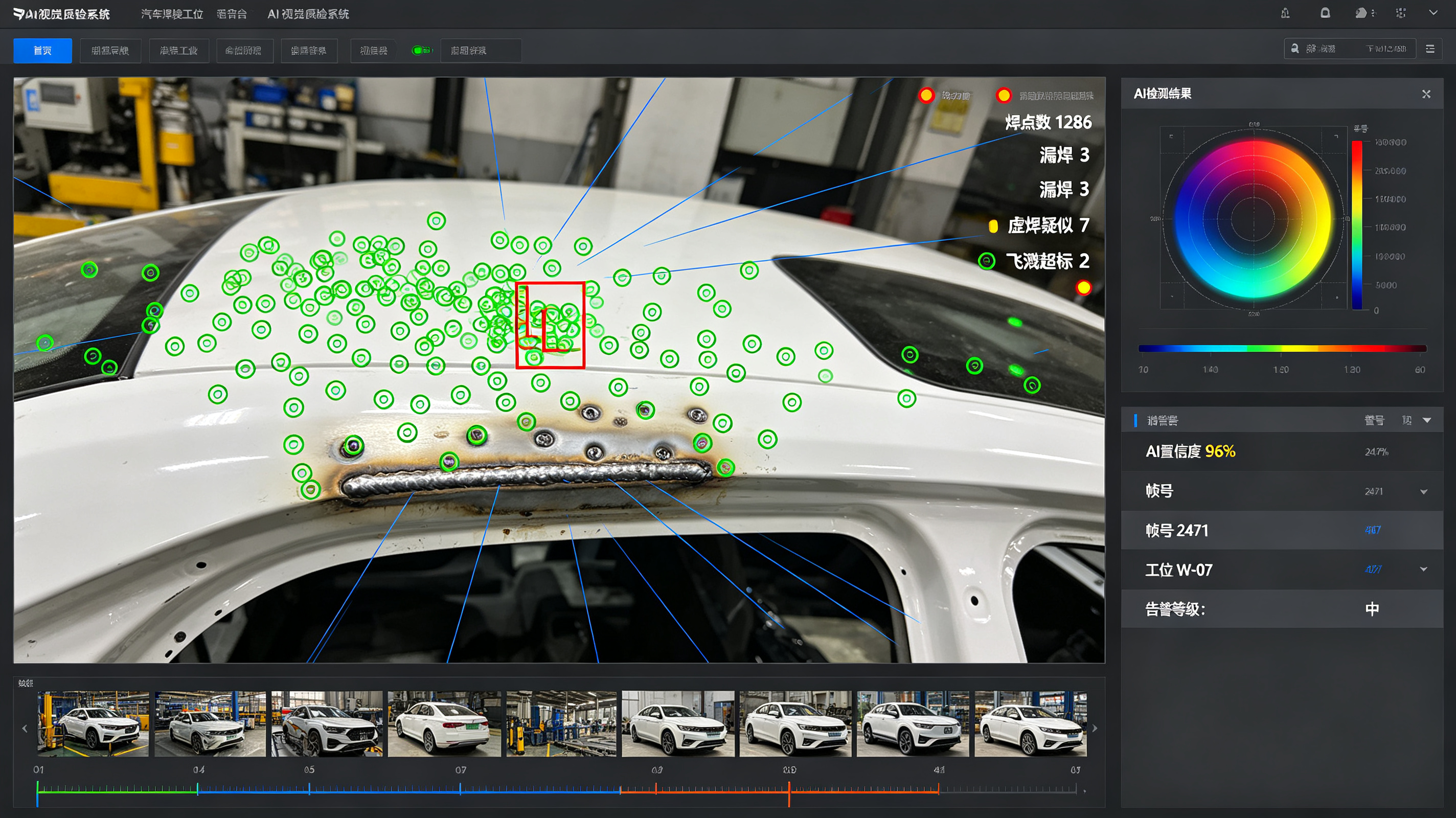
AI Visual Inspection System
1. Preface 1.1 Document Purpose This document is the user manual for the AI Visual Inspection System. It is intended to describe in detail all functional modules of the system, operating specifications, data storage mechanisms, parameter configuration, usage precautions, and fault handling procedures. It is designed to help operators, maintenance personnel, and management staff quickly master the system operation process, standardize inspection work standards, ensure stable equipment operation and secure retention of inspection data, and provide a complete guidance basis for intelligent factory inspection, quality traceability, and production optimization. 1.2 System Overview The AI Visual Inspection System is an intelligent industrial quality inspection platform built on deep learning, machine vision, image algorithms, and real-time data transmission technologies. It can replace manual labor in performing appearance defect detection, dimensional accuracy verification, material compliance inspection, and workstation status monitoring for various industrial products. The system features high precision, high speed, iterability, and traceability, and is adaptable to production lines in multiple industries, including electronics manufacturing, metal processing, plastics production, food packaging, and automotive components. The system supports dual-mode data storage and can flexibly switch between local storage and third-party cloud storage in the country of operation according to factory compliance requirements and data security needs, fully accommodating enterprise localization and cloud deployment requirements. 1.3 Scope of Application This manual applies to all factory operators, equipment maintenance personnel, quality management personnel, and system administrators who use, maintain, or manage the AI Visual Inspection System. It may also serve as a reference for system deployment, commissioning, and upgrade. 2. Overall System Functional Architecture The system is composed of seven core functional modules: the Image Acquisition Module, the AI Intelligent Inspection Module, the Real-Time Monitoring and Early Warning Module, the Data Storage Management Module, the Data Statistics and Analysis Module, the Equipment Operation and Maintenance Management Module, and the System Permission Management Module. The modules work in coordination to achieve fully automated operations across the entire workflow, from image acquisition, intelligent inspection, result output, data retention, and data analysis to equipment control. Among them, the Data Storage Module supports free switching between local storage and third-party cloud storage in the country of operation, a core featured function of the system. 3. System Function Description 3.1 Image Acquisition Module Image acquisition is the foundational module of the system's inspection operations. It is responsible for capturing high-definition images of products on the production line in real time to provide raw data for AI algorithm inspection, and supports multi-device adaptation and customized parameter adjustment for various scenarios. 3.1.1 Multi-Device Adaptive Acquisition The system is compatible with various industrial vision acquisition devices, including industrial high-definition cameras, high-speed frame cameras, infrared cameras, and macro cameras. It supports single-camera single-point acquisition and multi-camera synchronized stitching acquisition, and can accommodate the image acquisition needs of different inspection targets such as flat products, three-dimensional irregular products, and tiny precision components, meeting the requirements of different operation scenarios including high-speed production lines and static inspection workstations. 3.1.2 Customized Acquisition Parameter Configuration Operators can customize image acquisition parameters in the system backend, including resolution, frame rate, exposure, white balance, contrast, focal length, and fill-light mode. For production line scenarios with reflections, low light, strong light, or severe vibration, dedicated acquisition parameter templates can be preset and invoked with one click, ensuring that acquired images are clear, undistorted, and noise-free and safeguarding inspection accuracy at the source. 3.1.3 Automatic Capture and Trigger-Based Acquisition Multiple acquisition trigger modes are supported: automatic triggering by photoelectric sensors on the production line, timed continuous capture, manual button capture, and barcode-scan-linked triggering. Once a product reaches the inspection workstation, the system automatically completes image acquisition without manual intervention, adapting to uninterrupted automated production line operations and eliminating missed or erroneous captures. 3.2 Core AI Intelligent Inspection Module As the core function of the system, this module relies on deep learning algorithm models to perform intelligent analysis of acquired product images, accurately identifying various defects and nonconforming items. It supports custom model training and iterative upgrades. 3.2.1 Full-Category Intelligent Defect Detection The system can accurately identify common and subtle defects in industrial products, covering full-dimensional inspection of appearance, dimensions, assembly, stains, and damage. Appearance defects include scratches, cracks, paint peeling, deformation, bumps and dents, bubbles, and impurities; dimensional defects include length deviations, aperture diameter deviations, spacing beyond tolerance, angular errors, and misaligned edges; assembly defects include missing parts, wrong assembly, omitted installation, loosening, and misalignment; other defects include stains, wear, blurred characters, damaged packaging, and missing markings. Inspection accuracy can reach up to 99.9%. 3.2.2 High-Precision Automatic Dimension Measurement The system supports non-contact visual precision measurement and can automatically detect geometric parameters such as product length, width, height, aperture diameter, center-to-center distance, curvature, and flatness, automatically comparing them against product standard parameter thresholds to determine whether product dimensions are qualified. Measurement data is generated in real time with an accuracy of up to 0.01 mm, far exceeding manual inspection accuracy, and is suitable for precision component inspection scenarios. 3.2.3 Custom Model Training and Iteration The system features a built-in AI model training platform. Management staff can upload sample images for model training based on new products and new defect types at the factory. It supports rapid iteration with small sample sets, customizable defect labeling, and flexible adjustment of inspection thresholds. Trained models can be deployed online with one click without requiring professional algorithm personnel, adapting to the inspection needs of factory product iteration and process updates. The system also supports model version management, allowing model versions to be rolled back or upgraded at any time. 3.2.4 Real-Time Inspection Result Determination After image acquisition, the system completes algorithm analysis within milliseconds and automatically outputs inspection results in three determination states: Qualified, Unqualified, and Pending. For unqualified products, the system automatically marks the defect location, defect type, and defect level; products that cannot be determined due to blurred or occluded images are marked as Pending and flagged for manual re-inspection, avoiding false positives and missed detections. 3.3 Real-Time Monitoring and Early Warning Module This module enables visualized monitoring of the inspection process, real-time abnormal early warning, and linked production line control, ensuring orderly inspection operations and timely interception of defective products. 3.3.1 Visualized Real-Time Monitoring The system main interface supports synchronized display of real-time images from multiple workstations, allowing real-time viewing of inspection images on each production line, product inspection status, and real-time pass rates. It supports image enlargement, screenshots, recording, and full-screen viewing of a single workstation. Management staff can monitor the entire inspection process remotely or on site at any time, keeping abreast of the production line quality status in real time. 3.3.2 Multi-Level Abnormal Early Warning and Notification The system supports customized early warning rules, providing multi-level warnings for issues such as excessive defective products, equipment abnormalities, image acquisition failures, model inspection anomalies, and production line jams. Warning methods include pop-up interface alerts, equipment buzzer alarms, SMS notifications, and backend message pushes. Warning thresholds can be customized; for example, a defect rate exceeding 5% within a single hour automatically triggers a warning, promptly reminding staff to investigate production issues. 3.3.3 Production Line Linked Rejection The system supports integration with production line conveying equipment and sorting equipment. Upon detecting an unqualified product, the system automatically issues commands to stop the production line and have the sorting mechanism automatically reject the defective product, preventing defective products from flowing into the next process and achieving integrated automated inspection and rejection operations. Manual release of the linkage is also supported to accommodate manual re-inspection scenarios. 3.4 Dual-Mode Data Storage Management Module (Core Featured Function) The system supports two storage modes: in-plant local storage and third-party cloud storage in the country where the factory is located. It supports independent use of a single mode and synchronized backup using both modes. Users can freely configure storage according to enterprise data compliance requirements, storage needs, and network environment. All inspection data, image data, equipment logs, and analysis reports can be fully retained. 3.4.1 In-Plant Local Storage Mode This mode is an on-premises (privatized) deployment storage solution. All system data is stored in local storage devices such as in-plant servers, local hard drives, and disk arrays. Data is not transmitted externally and remains fully under the control of the factory intranet, making it suitable for enterprises with high data confidentiality requirements or prohibitions on data leaving the premises. Stored content: includes all system data, such as original inspection images of all products, defect-marked images, inspection parameter data, inspection result records, equipment operation logs, operation logs, statistical reports, model files, and early warning records. Core features: data localization, no external network transmission risk, extremely high security, and immunity to network fluctuations; the system can operate normally and retain data as usual even when disconnected from the network; supports periodic local data backup, manual backup, and automatic overwriting of expired data, with a customizable data retention period (configurable from 7 days to 10 years). Applicable scenarios: production of confidential products, production of high-precision precision components, enterprises with data localization compliance requirements, and production scenarios with unstable factory network conditions. 3.4.2 Third-Party Cloud Storage Mode in the Host Country This mode is a compliant cloud storage solution. The system encrypts and uploads various types of inspection data to compliant third-party cloud servers within the country where the factory is located. Data remains entirely within the host country throughout its lifecycle, strictly complying with local data security regulations and eliminating cross-border data transmission risks. Stored content: identical to local storage, covering full-volume data including image data, inspection results, equipment logs, report data, operation records, and early warning information; supports selective cloud storage, allowing inspection reports and key defect data to be uploaded separately to save cloud storage space. Core features: strong compliance, fully compliant with the host country's data storage and privacy protection regulations; off-site backup of data in the cloud avoids data loss caused by local hardware damage; supports remote data retrieval and cross-terminal data viewing; cloud data is automatically encrypted and stored with periodic snapshot backups, offering higher data security and durability. Applicable scenarios: production scenarios where enterprises require remote operation and maintenance, multi-facility data aggregation management, off-site data backup, or compliance with industry cloud-based traceability requirements. 3.4.3 Storage Mode Switching and Synchronization Configuration Free mode switching: system administrators can switch between local storage and cloud storage with one click on the backend storage settings interface. The operation is simple and requires no shutdown or restart, without affecting normal production line operations. Dual-mode synchronized backup: local and cloud dual storage can be enabled simultaneously, with real-time two-way data retention, balancing local data confidentiality and cloud data backup security. Customizable storage policies: differentiated storage rules can be configured, such as storing high-definition original images locally only while synchronizing inspection reports and statistical data to the cloud, precisely matching enterprise storage costs and data security requirements. Offline resumable upload: in cloud storage mode, if the factory's external network is interrupted, the system automatically stores data locally and automatically synchronizes it to the cloud in batches once the network is restored, with no data loss and no duplicate uploads. 3.4.4 Data Encryption and Security Management Both storage modes support end-to-end data encryption. Local storage uses intranet encryption protocols and hard drive encryption protection to prevent local data theft and tampering; cloud storage uses encryption algorithms compliant with host-country regulations, with full encryption throughout data transmission, storage, and retrieval. The third-party cloud platform provides storage services only and has no right to view or use the data, safeguarding enterprise data privacy and security. In addition, the system automatically records logs of all data retrieval, export, and deletion operations, ensuring full traceability. 3.5 Data Statistics and Analysis Module The system automatically aggregates all inspection data, performs intelligent statistical analysis, and generates visualized reports, providing data support for production optimization, quality control, and process improvement. 3.5.1 Real-Time Data Statistics Real-time statistics are generated for core data such as total production output, number of qualified products, number of unqualified products, number of pending products, real-time pass rate, and defect rate. Data is updated within seconds, allowing real-time viewing of inspection data by workstation, product, and time period. 3.5.2 Defect Data Analysis The system automatically classifies and counts the occurrence frequency, proportion, peak time periods, and peak workstations of various defects, generating defect distribution pie charts, trend line charts, and ranking bar charts. It precisely identifies production process problems, equipment failures, and raw material issues, assisting technical staff in optimizing production processes in a targeted manner. 3.5.3 Custom Report Generation and Export Custom inspection reports can be generated by hour, day, week, month, quarter, and year, containing complete information including production data, defect data, equipment operation data, and early warning records. Reports can be exported in multiple formats such as Excel, PDF, and images, and can be saved locally or archived in the cloud, facilitating quality review, reconciliation and audit, and compliance reporting. 3.5.4 Data Traceability Query Multi-dimensional precise traceability is supported. The original inspection images, inspection results, operating personnel, and equipment operation status of corresponding products can be queried with one click by conditions such as product batch, production time, workstation number, product barcode, and defect type, enabling full-lifecycle quality traceability of products. 3.6 Equipment Operation and Maintenance Management Module The system manages all associated visual inspection equipment in real time, providing equipment status monitoring, fault self-diagnosis, and maintenance record management to ensure long-term stable equipment operation. 3.6.1 Real-Time Equipment Status Monitoring The system monitors the operating status of industrial cameras, light sources, transmission equipment, servers, and storage devices in real time, including parameters such as equipment online status, operating temperature, frame rate, transmission rate, and storage space utilization, with real-time early warning for abnormal conditions. 3.6.2 Automatic Fault Self-Diagnosis and Repair The system features automatic equipment fault detection, capable of identifying issues such as camera offline, light source failure, image transmission anomalies, storage disk failures, and algorithm model anomalies. Some routine faults can be repaired automatically, such as restarting the image acquisition program and resetting transmission channels, reducing manual maintenance costs. 3.6.3 Operation and Maintenance Log Management All maintenance operations, including equipment power-on, power-off, faults, repairs, parameter adjustments, and model upgrades, are automatically recorded to generate complete operation and maintenance logs. Log query, export, and retention are supported, providing a basis for equipment maintenance, fault review, and equipment iteration. Customized equipment maintenance reminders are also supported, periodically reminding staff to complete equipment cleaning, calibration, and maintenance. 3.7 System Permission and Security Management Module Through tiered permission control, the module standardizes system operation processes, prevents misoperation, data tampering, and data leakage, and ensures system and data security. 3.7.1 Multi-Level Account Permission Management The system supports four levels of account permissions: Super Administrator, Operation and Maintenance Administrator, Quality Administrator, and General Operator. Different accounts correspond to different operation permissions: operators can only view real-time images, view inspection results, and manually trigger re-inspection; quality administrators can query data, export reports, and view defect analysis; operation and maintenance administrators can debug equipment, configure parameters, and manage storage modes; the super administrator has all permissions and can create, delete, and modify account permissions. 3.7.2 Full-Process Operation Logging The system automatically records all behaviors of every account, including logins, operations, parameter modifications, data exports, report deletions, and storage mode switching. Logs are tamper-proof and permanently retained, support query and traceability at any time, and help regulate personnel behavior. 3.7.3 System Security Protection The system supports encrypted account password login, IP login restrictions, remote login early warning, and automatic logout upon operation timeout, preventing unauthorized login and malicious operations. Backend parameters, model files, and storage configurations all require administrator permission to unlock, preventing arbitrary modification. 4. Basic System Operation Procedures 4.1 System Startup and Login Turn on the equipment power, start the server and the inspection system, and wait for the system to complete automatic initialization. Log in to the system with the dedicated account and password; the corresponding operation interface is displayed according to account permissions. After login, the system automatically checks the equipment connection status and storage mode status; operations can commence once no abnormalities are confirmed. 4.2 Storage Mode Configuration The super administrator logs in to the backend and enters the [Storage Management] configuration interface. Select the storage mode as needed: check “Local Storage” or “Cloud Storage”; both options can be checked simultaneously to enable dual-mode synchronized storage. Configure storage parameters: set the data retention period, automatic backup frequency, cloud synchronization rules, and expired data cleanup rules. Save the configuration; the system takes effect immediately without requiring a device restart. 4.3 Daily Quality Inspection Operations The operator logs in to the system, turns on the real-time monitoring screen, and confirms that image acquisition is normal. Invoke the inspection model and parameter template corresponding to the product, and start the automatic inspection mode. The system automatically completes the full workflow of acquisition, inspection, determination, data retention, and defective product rejection. For pending products and abnormal warnings, manual intervention is performed for re-inspection and handling, and the handling results are recorded. 4.4 Data Query and Report Export Enter the [Data Center] interface and select the query dimension (time, batch, workstation, or defect type). Filter the required data; the system automatically generates statistical charts and reports. Select the export format; data can be saved locally or synchronized to the cloud for archiving. 5. Data Storage Maintenance Specifications 5.1 Local Storage Maintenance Regularly check the storage space of local servers and disk arrays; promptly clean up expired data or expand hardware when storage space is insufficient. Perform a full data backup manually once a month to prevent data loss caused by hardware failures. Do not arbitrarily plug or unplug storage hardware or modify local storage folder paths, to avoid data corruption and loss. 5.2 Cloud Storage Maintenance Regularly check the stability of the factory's external network to ensure normal data synchronization. Log in to the cloud backend to check storage capacity and expand cloud storage space as needed. Strictly prohibit unauthorized modification of cloud encryption keys and storage permissions to safeguard cloud data security. 6. Common Faults and Troubleshooting Table 1 Common Faults and Troubleshooting Common Fault Symptom Fault Cause Troubleshooting Blurred or noisy image acquisition Abnormal acquisition parameters, lens contamination, light source failure Clean the camera lens, reset the acquisition parameter template, and inspect or replace the light source equipment Cloud data synchronization failure External network interruption, expired cloud permissions, incorrect encryption key Check the network connection and re-verify cloud permissions and the encryption key; data accumulated during the outage will be uploaded automatically Insufficient local storage space Expired data not cleaned up, storage capacity saturated Manually clean up expired redundant data, or expand local storage hardware Rising false-positive and missed-detection rates Aging AI model, unreasonable parameter thresholds Retrain and optimize the AI model, and adjust inspection determination thresholds Equipment offline, black monitoring screen Equipment power loss, loose cables, transmission fault Check the equipment power supply and cable connections, and restart the acquisition equipment and the system