Service Demo Video
APS Production Scheduling System
1 System Overview
1.1 System Introduction
The APS (Advanced Planning and Scheduling) system is a core digital system for the production operations of manufacturing enterprises. Built on the basis of finite capacity, it comprehensively considers multiple constraints such as orders, materials, equipment, personnel, processes, tooling and due dates, and generates scientific, executable production plans and scheduling solutions within minutes or even seconds. The system deeply integrates operations research optimization, artificial intelligence and industrial engineering methods, helping enterprises upgrade “production planning” from manual decision-making that relies on individual experience to data-driven, globally optimal intelligent decision-making. As a result, it significantly improves on-time delivery rates, equipment utilization and overall production efficiency, and serves as the key hub of the planning and management layer in a modern smart factory.
The system can be deployed either as an independent advanced scheduling tool or deeply integrated with existing enterprise information systems such as ERP, MES, WMS and SCM, building an integrated closed loop covering sales forecasting, master production scheduling, material requirements, capacity scheduling, shop-floor execution and data feedback, helping enterprises realize lean production and digital transformation.
1.2 System Positioning and Value
The system is positioned in the planning-management layer between “planning” and “execution”: upward, it receives sales orders, forecasts and demand plans from ERP; downward, it guides MES in shop-floor dispatching, process execution and on-site control. It is the key hub that connects the “Order–Planning–Execution–Feedback” closed loop. Its core value is reflected mainly in the following aspects:
First, improving on-time delivery. Based on finite capacity and material-availability constraints, the system performs scheduling and provides committable due dates (ATP/CTP), avoiding “easy to accept orders but hard to deliver” and significantly reducing delayed deliveries.
Second, lowering inventory levels. Through precise material requirements and production timing, it reduces work-in-process (WIP) accumulation and finished/semi-finished inventory occupancy, accelerating capital turnover.
Third, improving resource utilization. It globally coordinates the loads of equipment, tooling and personnel, identifies and relieves bottleneck resources, and reduces equipment idleness and load imbalance.
Fourth, enhancing responsiveness. Facing abnormalities such as order insertions, urgent orders, equipment failures and material shortages, the system can re-schedule within seconds and provide impact assessment to support rapid decision-making.
Fifth, supporting multi-factory and supply chain collaboration. It coordinates capacity and supply rhythm across multiple bases, enabling nearest and optimal order allocation.
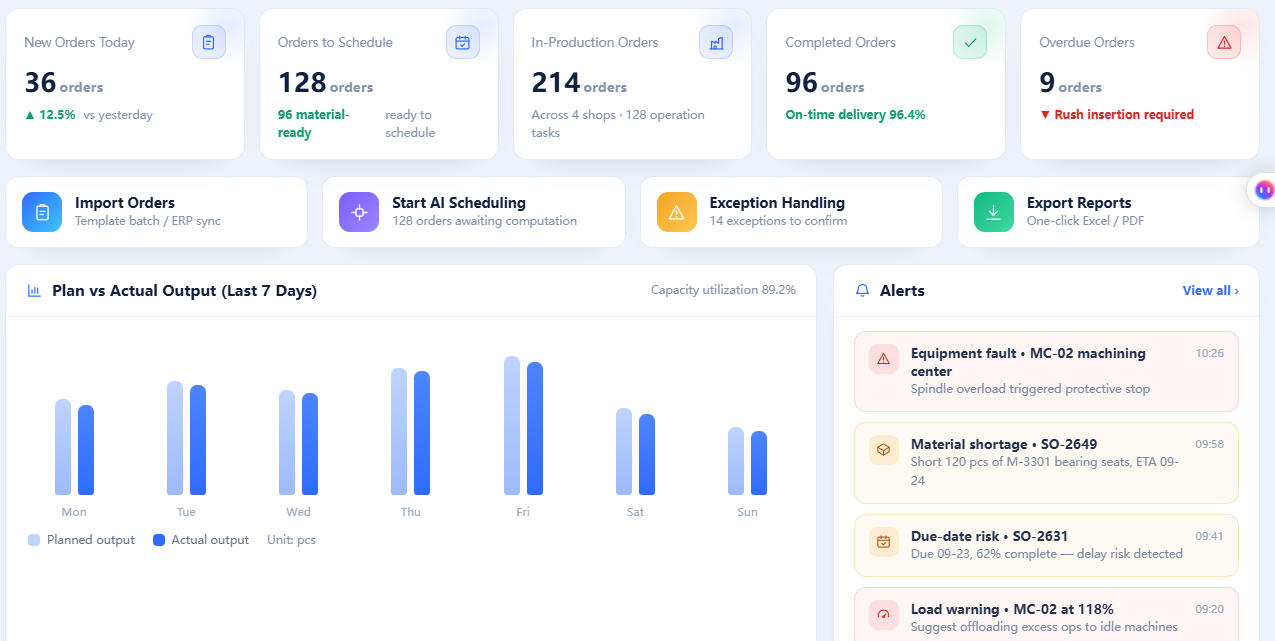
Sixth, data visualization. It presents the overall production picture in an intuitive manner through Gantt charts, load charts and delivery-delay warnings, supporting transparent management.
1.3 Core Functional Modules
1.3.1 Order Management
Supports aggregation, offsetting and merging of multi-source demand including sales orders, forecast orders, safety stock, finished-goods inventory and in-transit items. Combined with historical data and forecasting models, it generates time-phased demand to provide input for subsequent planning, and supports order prioritization, delivery commitment and change management.
1.3.2 Planning Management (MPS)
Based on aggregated demand and available inventory, it generates the master production schedule under key resource constraints, determining how many end products to produce at what time, balancing demand and capacity, and providing a stable and feasible production framework for material requirements planning.
1.3.3 Material Management (MRP)
Based on the master production schedule, bill of materials (BOM) and inventory/in-transit information, it explodes the required quantities and timing of materials at each level according to lead times, generating purchasing and in-house production plan recommendations to ensure material availability and timely supply.
1.3.4 Capacity Management
It performs rough-cut capacity analysis for medium- and long-term plans, identifies capacity gaps and load peaks, supports the addition, reduction and balancing of resources such as equipment, production lines and personnel, and provides a basis for capacity investment and balanced production.
1.3.5 Finite Capacity Scheduling (FCS)
Under the premise of finite capacity, it schedules each operation, each machine and each operator precisely down to day, shift or even minute. Taking into account due dates, priorities, changeover time, tooling and fixture constraints, and process constraints, it uses optimization algorithms to obtain a globally near-optimal solution, and serves as the core engine of the system.
1.3.6 Reporting Center
It presents scheduling results through visual dashboards such as Gantt charts, load charts, bottleneck analysis charts and delivery-delay warnings, supporting planners in drag-and-drop adjustment, conflict detection, solution comparison and “What-if” simulation to intuitively grasp the overall shop-floor picture.
1.3.7 Production Execution
Scheduling results can be issued to MES with one click or printed as dispatch orders. It collects execution data in real time such as completion, work reporting and equipment status, automatically compares the plan with actuals, triggers exception alerts for schedule deviations, material shortages and downtime, and supports exception-driven rapid re-scheduling.
1.3.8 Data Integration (ERP/MES/WMS)
It provides standard interfaces and adapters to connect with mainstream ERP, MES, WMS and SCM systems, enabling automatic synchronization of data such as orders, materials, BOM, inventory, capacity and work reporting, ensuring data consistency between planning and execution.
2 APS Industries and Typical Application Scenarios
The APS production scheduling system is widely applicable to manufacturing industries with complex scheduling constraints, multiple operations, multiple resources or due-date management requirements, especially suitable for discrete manufacturing, process manufacturing and the hybrid production modes of the two. The following selects typical industries including machinery equipment manufacturing, electronics and semiconductors, automotive and parts, food and beverage, pharmaceuticals and biopharmaceuticals, and printing and packaging. Combined with the production characteristics of each industry, typical application scenarios are introduced to explain how the APS system solves industry pain points and creates real value.
2.1 Machinery Equipment Manufacturing
Machinery equipment manufacturing is dominated by discrete processing, with many operations, complex process routes and strong equipment versatility. It generally features high-mix low-volume production, order-driven manufacturing and frequent order insertions, placing high demands on the granularity and responsiveness of scheduling.
2.1.1 Application Scenario 1: High-Mix Low-Volume Discrete Production Scheduling
Scenario background: Machinery equipment manufacturing enterprises generally face the production characteristics of “high-mix, low-volume, order-driven”. Order specifications are numerous, batch quantities are small, and process routes vary. The same workshop simultaneously handles multiple operations such as turning, milling, grinding, drilling, welding and assembly, with equipment and operators shared across operations. Manual scheduling that relies on the experience of planners is difficult to coordinate overall capacity comprehensively, easily resulting in an imbalanced situation of “some equipment overloaded in queues while other equipment idles”. When order insertions and urgent orders are frequent, scheduling plans are adjusted repeatedly, production preparation time is heavily occupied, and delivery commitments often diverge significantly from actual delivery.
System application process: After the system goes live, the enterprise imports all basic data such as in-process orders, finished and semi-finished inventory, equipment ledgers, personnel skills and process routes into the system, automatically expanding demand through MPS and MRP to form production tasks for each operation. With “finite capacity” as the constraint, the APS scheduling engine comprehensively considers factors such as order due dates, material availability, equipment availability windows, tooling and fixtures, and personnel shifts, uses optimization algorithms to generate a globally near-optimal scheduling solution within minutes, and presents the task arrangement of each machine through visual Gantt charts. When order insertions, urgent orders or equipment failures occur, planners can adjust tasks in the system, which evaluates the impact on due dates and capacity occupancy in real time and automatically provides re-scheduling recommendations. After confirmation, the scheduling results are issued to MES with one click, and the shop floor executes according to system instructions, feeding progress back in real time through work reporting, forming a closed loop of “Plan–Execution–Feedback–Adjustment”, significantly improving machine utilization and on-time delivery rates.
2.1.2 Application Scenario 2: Assembly and Material-Availability Scheduling for Large Equipment
Scenario background: The assembly of large equipment (such as machine tools, construction machinery and complete equipment sets) involves complex operations and long cycles, and involves material-availability (kitting) issues for a large number of purchased parts and self-manufactured parts. A shortage or delay of any key material or component can cause the entire assembly line to stop and wait for materials, resulting in serious schedule delays and resource waste. Meanwhile, scarce resources such as assembly sites, lifting equipment and specialized assembly personnel need to be reasonably allocated among multiple orders. How to ensure material kitting and the orderly connection of assembly resources is a common challenge for enterprises. In addition, demands for key resources from different orders often overlap in time, making it difficult for planners to coordinate the overall picture based on experience alone, and easy to attend to one thing while losing sight of another.
System application process: The APS system brings the complete BOM and assembly process of large equipment into unified management, backward-schedules the assembly plan based on order due dates, and expands the kitting requirements of components and materials forward in linkage. The system tracks the purchasing in-transit, inventory and in-house production progress of key materials in real time, identifies material-shortage risks in advance through kitting checks, and triggers alerts for purchase expediting or alternative solutions. In terms of assembly resource allocation, the system treats final assembly sites, key workstations, lifting equipment and assembly teams as constrained resources for finite capacity scheduling, reasonably arranging the assembly sequence of multiple large equipment items to avoid resource conflicts and idle time. When a deviation occurs at any stage, the system automatically recalculates the impact on the overall due date and provides adjustment recommendations, helping planners make rapid decisions and ensuring that large equipment is delivered on time. The system also provides kitting warning and delivery-risk dashboards, enabling management to grasp the progress of each project in real time and coordinate purchasing and production resources in a timely manner, forming a complete management closed loop from planning and execution to risk control, fundamentally reducing the risk of delayed delivery of large equipment.
2.1.3 Application Scenario 3: Machine Load Balancing and Bottleneck Scheduling in the Workshop
Scenario background: Machining workshops have many equipment types with large differences in processing capability, and often have obvious bottleneck equipment, such as heat-treatment furnaces and large machining centers. Since bottleneck operations determine overall capacity, if a large number of tasks accumulate in front of bottleneck equipment while other equipment idles, overall capacity is wasted and delivery is delayed. Manual scheduling is difficult to accurately identify and optimize bottlenecks, and often can only respond passively.
System application process: Through capacity analysis and bottleneck identification, the APS system automatically marks bottleneck resources in the workshop and arranges the production rhythm around the bottlenecks, balancing the task volume of upstream and downstream operations through a “push-pull” approach to avoid task accumulation or material interruption in front of bottleneck equipment. Taking load balancing as one of its objectives, the system reasonably allocates tasks among equipment based on due dates and processing efficiency, making the loads of similar equipment relatively balanced and reducing idleness and overload. When bottleneck equipment fails or capacity fluctuates, the system rapidly re-schedules and provides alternative equipment options and capacity adjustment recommendations, minimizing the impact on overall output. Through continuous load balancing and bottleneck scheduling, enterprises can significantly improve the capacity utilization of the entire workshop and shorten the manufacturing cycle. The load charts and bottleneck analysis reports provided by the system also offer objective data support for equipment investment, capacity planning and staffing, helping enterprises alleviate capacity bottlenecks at the source. At the same time, the system supports periodic output of bottleneck and load analysis results as a decision-making basis for production meetings and continuous improvement, continuously driving the improvement of workshop management.
2.2 Electronics and Semiconductors
The electronics and semiconductor industry has many process stages, a fast production rhythm and large equipment investment, with extremely high requirements on capacity utilization, yield and due dates. The granularity of scheduling directly affects the competitiveness of enterprises.
2.2.1 Application Scenario 1: PCB/SMT Line Takt Optimization and Changeover Scheduling
Scenario background: PCB (Printed Circuit Board) and SMT (Surface Mount Technology) production lines have expensive equipment and many lines, with frequent product model changeovers. Changeovers, material replacements and stencil changes between different models require long preparation times, directly affecting the effective output of production lines. If changeovers are arranged improperly, a large amount of capacity is wasted; if task allocation is uneven, some lines are queued while others idle. How to reduce changeover times and improve line utilization through reasonable batch merging and sequencing while meeting due dates is a key concern of the industry.
System application process: The APS system incorporates equipment and process parameters such as SMT lines, placement machines, printers and reflow soldering machines into the model, and performs intelligent batch splitting and sequencing of orders with “reducing changeovers, balancing loads and meeting due dates” as scheduling objectives. The system automatically identifies orders of the same or similar models and merges them for production, arranging a reasonable changeover sequence to shorten the total material-replacement and setup time; at the same time, it allocates tasks in a balanced manner according to the capability and load of each line to avoid load imbalance among lines. On the visual dashboard of scheduling results, planners can intuitively view the task arrangement and changeover points of each line, make drag-and-drop adjustments and evaluate the impact on due dates. After the scheduling results are issued to MES, the shop floor changes over and produces according to system instructions, and feeds execution progress back through real-time data, achieving efficient line operation and rapid changeover, significantly improving equipment utilization and order delivery capability. Through continuous takt optimization and changeover management, enterprises can substantially reduce production preparation costs, shorten order delivery cycles and enhance market competitiveness.
2.2.2 Application Scenario 2: Capacity-Constrained Scheduling for Semiconductor Packaging and Testing
Scenario background: The semiconductor packaging and testing stage involves numerous operations and complex equipment types, including grinding, dicing, die attach, wire bonding, molding, plating and testing, with large differences in process routes and equipment capabilities across products. Packaging and testing equipment is of high value and capacity is highly tight, so the scheduling of key equipment directly affects overall output and due dates. At the same time, the semiconductor industry has strict requirements on yield, batch traceability and clean environment, and scheduling needs to balance process constraints and production specifications, making it extremely complex.
System application process: The APS system incorporates the equipment, capacity, process constraints and product batches of the entire packaging and testing process into a unified model, performs finite capacity scheduling around key bottleneck equipment, reasonably allocates the production timing of each product batch on different operations and equipment, and balances overall capacity. The system supports batch merging, error-proofing constraints, cleanroom constraints and equipment PM (Preventive Maintenance) time constraints, ensuring that scheduling complies with process specifications. In response to abnormalities such as urgent order insertions and equipment downtime, the system can rapidly re-schedule, evaluate the impact on due dates and capacity, and provide the optimal adjustment plan. At the same time, the system is linked with MES to obtain equipment status and completion data in real time, achieving two-way collaboration between scheduling and execution, helping packaging and testing enterprises maximize the utilization of expensive capacity and guarantee delivery commitments to key customers. The transparency and automation of scheduling also significantly reduce the workload of planners and improve the scientific rigor and timeliness of planning management.
2.3 Automotive and Parts
The automotive and parts industry is characterized by large-scale, assembly-line, takt-based production and high requirements for supply chain collaboration. Both vehicle manufacturers and parts enterprises need to achieve efficient production scheduling under strict due dates and high quality requirements.
2.3.1 Application Scenario 1: Sequencing Optimization for Mixed-Model Production Lines at Vehicle Plants
Scenario background: Modern vehicle plants generally adopt mixed-model production lines, producing multiple models and configurations of vehicles on the same assembly line simultaneously. This must satisfy both the personalized needs of customer orders and the stability and efficiency of production takt. The work-hour differences, material supply and workstation loads of different models on the assembly line vary, and improper sequencing can cause problems such as line-side material shortages, workstation bottlenecks and increased model-changeover time, leading to capacity loss and delivery delays. How to meet the due dates and priorities of orders without sacrificing efficiency is the core difficulty of vehicle scheduling.
System application process: Based on the vehicle order pool and assembly-line constraints, the APS system performs intelligent optimization of the production sequence. The system integrates factors such as model work-hours, workstation loads, material kitting, color and configuration changeover costs, customer due dates and transportation plans to build a scheduling optimization model, generating the optimal vehicle sequence that both meets order requirements and takes into account the stability of the production line. The system performs kitting checks on line-side materials, warns of material-shortage risks in advance and links pull replenishment; it also balances the loads of key workstations to avoid local congestion. After the sequencing results are issued to MES and the pull system, line-side feeding and assembly proceed in sequence, and the plan is continuously calibrated through real-time feedback. The system can also link the sequencing results with transportation and shipment plans, optimizing the connection between vehicle completion and delivery, further compressing in-transit time and inventory and improving the efficiency of full-chain delivery. The generation and adjustment of sequencing plans are fully documented and traceable, facilitating review and continuous improvement by production management. Through mixed-model sequencing optimization, vehicle plants can maintain high-takt stable production while satisfying personalized needs, improving delivery efficiency and customer satisfaction.
2.3.2 Application Scenario 2: Multi-Operation Multi-Line Collaborative Scheduling for Parts
Scenario background: Automotive parts enterprises have many product types, large batch quantities and strict due dates, and often need multiple workshops and production lines to collaborate on completing an order, involving operations such as stamping, machining, surface treatment, assembly and inspection. The loads of different lines affect one another, and imbalanced capacity or uncoordinated scheduling can lead to semi-finished goods accumulation and delivery delays. At the same time, parts enterprises have a wide variety of parts and frequent mold changes and line changeovers. How to coordinate among multiple lines to achieve balanced production and on-time delivery is a key management challenge. Facing increasingly strict delivery requirements and frequent demand fluctuations from OEMs, scheduling based on experience alone is no longer adequate.
System application process: The APS system incorporates the equipment capacity and process constraints of all workshops and production lines into a unified model, performs integrated multi-operation multi-line scheduling of orders, and automatically plans the processing timing and quantities of each operation on each line, achieving collaborative linkage across workshops and lines. Through load analysis, the system identifies capacity weaknesses and balances task allocation across lines, reducing WIP accumulation and line idleness; through material kitting checks and mold resource constraints, it avoids stoppages caused by material shortages or untimely mold changes. When an OEM order is adjusted or a line experiences an abnormality, the system rapidly re-schedules and adjusts related operations in linkage, ensuring that the overall plan remains feasible. The load and progress dashboards provided by the system help management grasp the operating status of each line in real time, promptly warn and handle risks, and significantly improve the executability of plans and overall operational efficiency. Through integration with OEM supply chain systems, it achieves collaboration of order and delivery information, helping parts enterprises improve on-time delivery rates and internal operational efficiency.
2.3.3 Application Scenario 3: Pull-Based Replenishment and Kitting Scheduling in the Supply Chain
Scenario background: In the automotive and parts supply chain, OEMs often use kanban or rolling demand plans to pull parts supply, with high requirements on arrival timing and kitting. Parts enterprises need to organize production and distribution in a timely manner according to the pull signals of OEMs, avoiding both stock-outs that stop lines and excessive inventory. Facing pull demands from multiple customers, multiple models and multiple products, traditional scheduling is difficult to precisely match the arrival rhythm, easily resulting in the problem of “items that should be supplied are not supplied, while items that should not be supplied accumulate”.
System application process: The APS system connects with the demand plans of OEMs, automatically receives pull signals and rolling orders, and converts demand into production tasks and distribution plans for each line. The system schedules with pull logic, organizes production as needed and backward-schedules the production timing of each operation to ensure that finished goods are kitted and completed before the demand point; through safety stock and kitting monitoring, it identifies supply risks in advance and triggers replenishment warnings. The system simultaneously coordinates the priorities and delivery windows of multiple customers, optimizes the production and distribution sequence, and improves vehicle loading and distribution efficiency. Through precise matching of supply and demand rhythm, enterprises can significantly reduce urgent replenishment and stock-out losses, effectively lower inventory while guaranteeing the continuous production of OEMs, enhance the resilience and responsiveness of the supply chain, and improve the overall level of supply chain collaboration. The system also places the supply assurance of key customers under key monitoring, prioritizing important orders when risks arise, balancing delivery performance and customer satisfaction.
2.4 Food and Beverage
The food and beverage industry belongs to process manufacturing, characterized by batch production, continuous production, high hygiene requirements and shelf-life sensitivity. Scheduling needs to balance line continuity, cleaning changeovers and freshness constraints.
2.4.1 Application Scenario 1: Continuous-Flow and Batch Production Scheduling
Scenario background: The production lines of food and beverage enterprises are mostly continuous-flow or semi-continuous-flow production, with high equipment start-up/shutdown and cleaning costs, and changeovers between different products often require preparation times such as cleaning and disinfection. If scheduling is improper, frequent product changeovers occupy a large amount of production time and reduce capacity utilization; at the same time, the supply and inventory of raw materials and packaging materials need to match the production rhythm. In addition, the shelf life and procurement cycles of raw materials need to be closely linked with the production plan, making scheduling highly complex and difficult to coordinate manually. How to reasonably merge batches of similar products, reduce changeover times and maintain continuous and efficient line operation while meeting order due dates is an important topic for food and beverage enterprise scheduling.
System application process: The APS system incorporates line equipment, capacity, cleaning rules and changeover times into the scheduling model, and optimizes the sequence of production batches with “reducing changeovers, balancing loads and meeting due dates” as objectives. The system merges batches of products with the same or similar formulations, reasonably arranges the production order of different products, coordinates the load allocation of each line, and avoids local overload or idling. At the same time, the system links the inventory and supply of raw materials and packaging materials to ensure that the production plan is consistent with material kitting and avoid line stoppages due to material shortages. Scheduling results are presented through a production plan dashboard, supporting planners in drag-and-drop adjustment and delivery-impact evaluation, and are issued for execution after confirmation. The capacity and load dashboards provided by the system help management intuitively grasp line operation and respond to demand fluctuations and plan adjustments in a timely manner. Through continuous-flow and batch-optimized scheduling, enterprises can significantly improve line utilization, reduce cleaning and changeover costs, and ensure on-time order delivery.
2.4.2 Application Scenario 2: Order Scheduling under Shelf-Life Constraints and FIFO
Scenario background: Food and beverage products have short shelf lives and high freshness requirements, so production and inventory management must strictly follow the First-In-First-Out (FIFO) principle to avoid losses caused by product expiration. In order scheduling, it is necessary to comprehensively consider raw material freshness, production dates, shelf life, warehouse turnover and customer requirements for freshness, and reasonably arrange the production sequence and quantities so that products are delivered to customers in the best condition. If scheduling does not consider shelf-life constraints, problems such as some product inventory accumulating and expiring, or some orders failing to meet freshness requirements, may occur.
System application process: The APS system introduces shelf-life and FIFO constraints into the scheduling model, and intelligently plans the production timing and quantities of each order by integrating raw material batches, production dates, finished-goods shelf life and order requirements. According to the FIFO principle, the system preferentially consumes the earliest batches of raw materials and inventory, and reasonably arranges the production plan so that finished-goods inventory maintains reasonable turnover; at the same time, combined with warehouse capacity and turnover speed, it avoids overproduction causing accumulation. For the shelf-life and freshness requirements of different customers, the system optimizes scheduling on the basis of meeting due dates, prioritizing the early production of freshness-sensitive orders. The system also supports linked warnings for near-expiry inventory and orders, further safeguarding product freshness and sales safety. Through intelligent scheduling under shelf-life constraints, enterprises can effectively reduce expiration losses, ensure product quality and customer satisfaction, and improve inventory turnover efficiency.
2.5 Pharmaceuticals and Biopharmaceuticals
The pharmaceutical and biopharmaceutical industry is strictly constrained by GMP regulations, with extremely high requirements on production batches, equipment cleaning, validation and traceability. Scheduling must balance compliance, safety and efficiency.
2.5.1 Application Scenario 1: Batch Production Records and GMP-Compliant Scheduling
Scenario background: Pharmaceutical manufacturers must strictly comply with GMP (Good Manufacturing Practice). The production of each batch must follow established batch production instructions and process regulations, and the relevant records must be complete and traceable. Production scheduling must ensure that elements such as batch production instructions, batch records, and equipment and personnel qualifications meet regulatory requirements, avoiding quality risks and inspection deficiencies caused by conflicts between scheduling and compliance requirements. At the same time, pharmaceutical production has long cycles and strict batch management, and the collaborative scheduling of multiple products and batches places high demands on planning capability. Any omission at the planning level may lead to compliance risks and economic losses, so scheduling must be rigorous and reliable.
System application process: The APS system embeds GMP compliance constraints in scheduling, incorporating batch production instructions, process regulations, equipment qualifications, personnel qualifications and validation status into scheduling validation conditions, ensuring that only qualified equipment and personnel are scheduled into production tasks. The system organizes batch production plans according to batch-number specifications and generates the planning information required for batch production records in linkage, ensuring complete batch traceability. The system optimizes the production timing of each batch, coordinates the production rhythm and material supply of multiple products, and ensures production by batch and by quantity, avoiding compliance conflicts. When process changes or validation status changes occur, the system promptly prompts and re-validates the feasibility of scheduling. Through the integration of scheduling and compliance management, pharmaceutical enterprises ensure quality and regulatory requirements while improving the scientific rigor and execution efficiency of production planning, effectively supporting compliant and efficient pharmaceutical production. The scheduling and batch information generated by the system can also directly interface with batch record systems, reducing manual transcription errors and improving data consistency.
2.5.2 Application Scenario 2: Equipment Cleaning and Changeover Time-Constrained Scheduling
Scenario background: Pharmaceutical and biopharmaceutical production has extremely strict control of cross-contamination. Changeovers between different products and batches usually require strict equipment cleaning, disinfection and even validation, and the cleaning and validation time sometimes approaches or even exceeds production time, making it a key factor affecting capacity. If cleaning is arranged improperly, it can cause equipment idle waste or product quality risks. How to coordinate cleaning, disinfection, validation time and production tasks to maximize capacity utilization is an important difficulty in pharmaceutical scheduling.
System application process: The APS system treats equipment cleaning, disinfection and validation time as mandatory scheduling constraints. Based on product compatibility rules, it automatically plans a reasonable production and cleaning sequence to minimize invalid downtime caused by product changeovers. The system prioritizes scheduling for equipment requiring long cleaning cycles, reduces cleaning times through batch merging of similar products, and reasonably arranges the connection between cleaning validation and other production tasks to improve overall equipment utilization. At the same time, the system tracks equipment status in real time and restricts the scheduling of tasks onto equipment when cleaning or validation is not completed, ensuring compliance. Scheduling results are linked with the equipment status dashboard, helping workshops reasonably arrange cleaning and production rhythm. Through intelligent scheduling under cleaning and changeover constraints, pharmaceutical enterprises can significantly improve the utilization and overall capacity of expensive production equipment while strictly meeting GMP requirements. Through the coordinated optimization of cleaning validation time and production tasks, enterprises can effectively release capacity and shorten product delivery cycles.
2.6 Printing and Packaging
The printing and packaging industry has many order types, diverse colors and specifications, and frequent plate and color changes. Printing and downstream processes are tightly connected, with high requirements on imposition, color management and delivery control.
2.6.1 Application Scenario 1: Multi-Order Imposition and Color Changeover Optimization
Scenario background: Printing and packaging enterprises undertake a large number of orders with various specifications. Press plate changes, color adjustment and ink adjustment require long preparation times, and orders of different color groups and processes change over frequently. If each order is run separately on the machine, a large amount of plate-changing, color-adjustment time and material waste results; if imposition is improper, it affects printing quality and the connection of downstream operations such as die-cutting and lamination. The connection quality of these links directly affects the delivery quality and cost of orders, placing high demands on the experience of planners, and manual scheduling finds it difficult to balance efficiency and quality. How to reduce the number of plate and color changes and increase the output of printing presses through reasonable imposition and production sequencing is the key to improving the efficiency of printing enterprises.
System application process: The APS system incorporates resources and process constraints such as printing presses, printing plates, inks and paper into the scheduling model, supports intelligent imposition and merging of orders based on factors such as paper specifications, color similarity and process consistency, and combines orders suitable for same-machine production into the same batch, reducing the number of plate and color changes. The system performs finite capacity scheduling for printing presses, reasonably arranges the order-of-run and load allocation of each order, and coordinates the connection between printing and downstream operations such as die-cutting, lamination and binding to avoid upstream accumulation or downstream waiting for materials. Scheduling results are presented through visual dashboards, where planners can view the task arrangement and plate-change points of printing presses, optimize and adjust, and then issue for execution. The imposition and scheduling dashboards provided by the system help planners intuitively grasp press tasks and plate-change points and make timely optimizations and adjustments. Through imposition and color changeover optimization, printing enterprises can significantly reduce setup and material waste, improve press utilization and delivery efficiency, and enhance market competitiveness.
2.6.2 Application Scenario 2: Load Balancing and Due-Date Scheduling for Offset/Flexographic Lines
Scenario background: Printing and packaging enterprises often have multiple types of printing equipment simultaneously, such as offset, flexographic and digital printing. Different equipment is suitable for orders of different materials and processes, and there are load differences among production lines. Order due dates are strict, and urgent orders and order insertions are frequent. If scheduling is imbalanced, some lines may be overloaded while others idle, or urgent orders cannot be inserted in a timely manner, affecting customer delivery and satisfaction. In addition, the cost and quality differences among different printing processes are obvious, and whether orders are properly matched to production lines directly affects the cost control and delivery capability of the enterprise, making it difficult for manual scheduling to coordinate comprehensively.
System application process: The APS system intelligently matches orders to the most suitable production lines according to the process capability of each printing device and the characteristics of orders, coordinates the load allocation of multiple lines such as offset, flexographic and digital printing, and achieves overall capacity balance. The system schedules with due dates as the core constraint, prioritizing urgent and important orders and responding rapidly to order insertions: when an urgent order appears, planners evaluate its impact on the existing plan in the system, and the system automatically provides the optimal insertion position and adjustment solution. The system links materials (paper, ink and plate materials) and the capacity of downstream operations to ensure that the production plan is executable. The scheduling dashboards and progress tracking provided by the system help enterprises achieve transparent management of the full process from order acceptance and scheduling to delivery, and promptly identify and handle progress risks. Through line load balancing and due-date scheduling, printing and packaging enterprises can improve overall capacity utilization and order response capability while guaranteeing due dates, enhance market competitiveness, and lay a solid foundation for undertaking more quality orders.
المواصفات
الميزات الرئيسية
- 1. Constrained Intelligent Scheduling: Based on a finite capacity model, it integrates multi-dimensional constraints including orders, materials, equipment, personnel and processes, and can quickly generate feasible production scheduling plans at minute or second level.
- 2. Data-Driven Global Optimization: Combining operations research optimization, AI and industrial engineering methods, it transforms traditionally experience-based manual scheduling into globally optimal intelligent decision-making, improving on-time delivery rate, equipment utilization and production efficiency.
- 3. Flexible Deployment and Strong Adaptability: It supports standalone deployment and can also be integrated with mainstream industrial information systems such as ERP, MES, WMS and SCM.
- 4. Full-Link Business Closed-Loop Enablement: It covers the entire workflow including sales forecasting, master production planning, material requirements planning, capacity scheduling, shop floor execution and data feedback, supporting enterprises in lean production and digital transformation.