Product Demo Video
The HS-series industrial manipulator systems
1 Product Overview
The HS-series industrial robotic arm system is designed for industrial automated production lines, delivering a combination of precision, stability, and versatility as an intelligent operation solution. Its flagship models are the HS-RA100, HS-RA300, and HS-RA500. Built on a modular structure and driven by high-performance servo drive units and intelligent motion control algorithms, the system offers accurate positioning, fast cycle times, a wide payload range, and easy interfacing with peripheral equipment, and is capable of performing six mainstream industrial operations: palletizing, welding, spray painting, assembly, cutting, and inspection and sorting.
The three models correspond to the light, medium, and heavy payload classes respectively, allowing free model selection based on production line conditions, precision requirements, and working radius. Served industries include machinery manufacturing, automotive and auto parts, hardware processing, electronics and electrical equipment, chemical and building materials, and logistics and warehousing. With 24-hour continuous operation capability, the robotic arms take over repetitive, high-intensity, high-risk, and high-precision tasks from manual labor, thereby reducing labor costs, improving output efficiency, and ensuring consistent processing results across batches, in support of the automation and intelligence upgrade of production lines. In addition, the series adopts a standardized maintenance structure and built-in intelligent self-diagnostics, offering easy maintenance, low failure rates, and a long service life, with outstanding industrial application value.
2 Product Models and Core Specifications
The HS-RA100, HS-RA300, and HS-RA500 belong to the same series and share consistent structure, control system, and adaptable operating scenarios. Their differences are primarily reflected in hardware indicators such as payload, working radius, and motion speed, facilitating model selection according to specific operating conditions. Detailed technical specifications for each model are shown in the table below:
Technical Specification | HS-RA100 | HS-RA300 | HS-RA500 |
| Maximum rated payload | 10 kg | 30 kg | 50 kg |
| Maximum working radius | 1200 mm | 1800 mm | 2200 mm |
| Repeat positioning accuracy | ±0.03 mm | ±0.05 mm | ±0.08 mm |
| Degrees of freedom | 6 axes | 6 axes | 6 axes |
| Maximum motion speed (end effector) | 6.5 m/s | 5.8 m/s | 5.2 m/s |
| Drive method | All-servo motor drive | All-servo motor drive | All-servo motor drive |
| Control system | HS Intelligent CNC System | HS Intelligent CNC System | HS Intelligent CNC System |
| Operating temperature | 0°C–45°C | 0°C–45°C | 0°C–45°C |
| Protection rating | IP65 | IP65 | IP65 |
| Rated power | 2.2 kW | 3.8 kW | 5.5 kW |
| Machine weight | 185 kg | 320 kg | 480 kg |
| Mounting method | Floor / wall / inverted | Floor / wall / inverted | Floor / wall / inverted |
| Applicable operating scenarios | Welding of small workpieces; spray painting; precision assembly; inspection and sorting of small parts; palletizing of light materials; cutting of small workpieces | Welding of medium workpieces; full-surface spray painting; general assembly; routine inspection and sorting; palletizing of medium materials; cutting of regular workpieces | Palletizing of heavy materials; welding of large workpieces; spray painting of large parts; assembly of heavy components; inspection of large parts; cutting of thick materials |
3 Core Application Scenarios
3.1 Palletizing Application Scenario
Scene background: Palletizing sits at the junction between production and warehousing logistics and is a critical link, commonly found in industries such as food and beverage, chemical, building materials, home appliances, and logistics and warehousing. It handles the stacking, transfer, inbound, and outbound of finished products, semi-finished goods, and raw materials. The traditional labor-intensive palletizing method presents several significant problems. First, it is physically demanding: repeated bending and lifting movements put employees at risk of lumbar strain and joint injuries, making positions difficult to retain and recruit for. Second, stacking quality varies from person to person, with skewed stacks, collapsing goods, and inconsistent layer counts occurring from time to time, which lowers warehouse space utilization and weakens transport safety. Third, manual cycle times cannot keep pace with the high-speed output of modern production lines, labor costs keep rising year after year, and cargo damage and rework caused by mishandling continue to add operational burdens. In addition, chemical and building materials often carry dust or slight corrosiveness, and long-term exposure is detrimental to worker health. Therefore, using automated equipment to achieve standardized palletizing has become a common industry requirement. Uniform stack patterns, controlled layer counts, and stable cycle times facilitate full utilization of warehouse space and enable convenient forklift transfer and inbound/outbound management.
Equipment application process: The three models can be selected according to the weight and size of the materials, allowing the palletizing process to be completed automatically. Before production, technicians preconfigure palletizing trajectories, stacking layers, stack parameters, and gripping spacing in the HS Intelligent CNC System, adapting them to different material forms such as cartons, bags, drums, and cases. After materials are delivered by the conveyor line to the designated pickup station, the robotic arm performs positioning with the pneumatic gripper or vacuum suction fixture installed at the end effector, then executes gripping, lifting, and translation, placing materials smoothly onto pallets or warehouse racks at the target position according to the preset program. In terms of division of labor, the HS-RA100 targets light materials under 10 kg, such as snacks, small accessories, and lightweight cartons; the HS-RA300 handles medium materials of 30 kg, such as grain and oil products, medium-sized chemical bags, and home appliance accessories; and the HS-RA500 handles heavy materials of 50 kg, such as building material panels, large drum raw materials, and full heavy cases. During operation, the onboard intelligent sensing system continuously detects material position deviations and automatically fine-tunes the motion trajectory, compensating for pickup errors caused by conveyor line offset. The entire process requires no manual intervention and can continuously perform stacking, pallet replacement, and empty-pallet exchange cycles, meeting the needs of 24-hour continuous production on the line.
Equipment maintenance advantages: Under palletizing conditions, the series excels in ease of maintenance and operational stability. The fully enclosed dustproof structure, with an IP65 protection rating, prevents dust and debris in warehouses and workshops from intruding, reducing common faults caused by accumulated dust such as jamming or sensor malfunction. The core transmission components are made of high-strength alloy materials that are wear-resistant and durable, capable of withstanding high-frequency, high-load reciprocating motion with significantly slowed wear. The onboard intelligent self-diagnostic system continuously monitors parameters such as motor temperature, operating load, trajectory deviation, and gripper status, issuing automatic warnings and storing fault codes at the first sign of minor abnormalities, enabling maintenance personnel to quickly locate and resolve issues and preventing minor problems from accumulating into downtime incidents. The equipment also adopts a modular disassembly approach: grippers, servo motors, transmission bearings, and other wear parts can be replaced individually without disassembling the entire machine, reducing maintenance time and cost. Compared with manual palletizing and general palletizing equipment, the HS-series robotic arms have fewer faults and longer service lives, with an average annual maintenance investment of less than 10% of manual labor wages, and require no frequent downtime for maintenance, maximizing continuous production line operation.
3.2 Welding Application Scenario
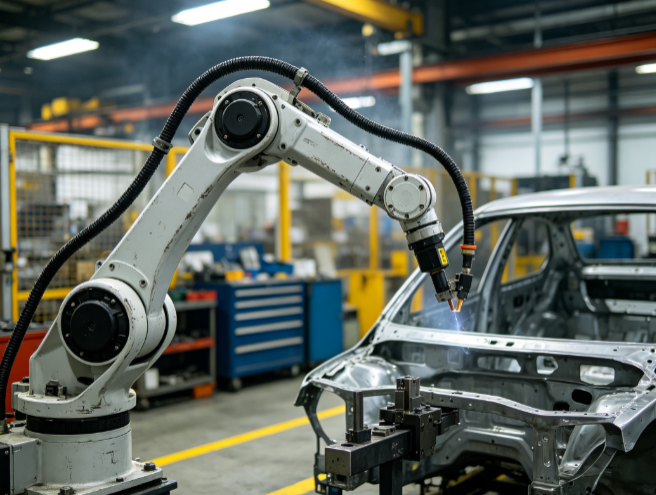
Scene background: Welding is a fundamental process in industries such as machinery manufacturing, automotive and auto parts, hardware steel structures, and engineering machinery. It encompasses various processes including spot welding, arc welding, laser welding, and gas-shielded welding, and mainly completes the splicing, fixing, and forming of metal workpieces. The drawbacks and safety risks of manual welding are both prominent. Operations involve intense light, high temperatures, fumes, and arc radiation; long-term exposure can damage the operator's eyesight, respiratory system, and skin, making it a high-risk specialty post. Weld quality depends on the skill level and real-time condition of the welder, making it difficult to maintain consistent weld width, penetration depth, and spot uniformity. Defects such as cold welds, missed welds, weld beads, and deformation are common, and the qualification rate fluctuates considerably. Meanwhile, experienced welders are scarce and highly paid, and manual speed is limited, making it difficult to support high-volume, standardized production of workpieces. For complex irregular parts, confined spaces, or high-precision requirements, manual operation becomes even harder and precision harder to guarantee. The industry therefore has an urgent need for high-precision automated welding equipment.
Equipment application process: The HS-series models can undertake welding tasks for various metal workpieces, with the three models matched according to workpiece size, weight, and welding conditions. Specialized end effectors such as laser welding heads, gas-shielded welding torches, and spot welding fixtures can be installed, and when combined with the vision positioning system, fully automatic precision welding is achieved. During preparation, staff enter process parameters such as welding trajectory, welding speed, penetration depth, and dwell time into the control system based on the workpiece drawings, and batch production can begin after the program passes commissioning. During processing, the workpiece is fixed on the welding station by fixtures, and the robotic arm quickly identifies its position and contour through high-definition visual scanning, automatically corrects the welding points, and continuously performs welding strictly along the preset trajectory. In terms of division of labor, the HS-RA100 offers extremely high positioning accuracy, suitable for delicate welding of light precision parts such as electronic hardware parts, precision auto parts, and small pipes; the HS-RA300 is intended for batch welding of regular workpieces such as automotive parts, medium steel structures, and hardware frames; and the HS-RA500 handles large and heavy workpieces such as large engineering machinery accessories, heavy steel structures, and large pipes, with stable welding performance. The 6-axis flexible motion structure enables flexible multi-angle welding of flat, curved, and irregular parts with no dead zones; after each workpiece is welded, the arm automatically resets and waits for the next group, forming a fully automated closed loop.
Equipment maintenance advantages: In response to the high temperatures, fumes, and electromagnetic interference of welding sites, the HS-series models feature targeted protection with clear maintenance advantages. The machine body is coated with high-temperature-resistant, corrosion-resistant materials that withstand high-temperature burning, fume erosion, and weld spatter, resisting deformation and rust while maintaining stable appearance and performance over long service. The core circuits and control system adopt sealed shielding treatment to isolate electromagnetic interference generated by welding, preventing signal disorder and program drift and ensuring long-term welding precision without degradation. The equipment features process parameter memory: once commissioned, parameters are saved permanently and can be recalled without re-tuning, reducing human error and eliminating repeated commissioning losses. The fault self-diagnostic system continuously tracks welding trajectory deviation, equipment load, and abnormal temperatures, providing early warnings to avoid entire batches of defective products. Wear parts such as welding torches, sensors, and transmission components are all standardized universal parts that are easy to purchase and replace; routine maintenance only requires periodic cleaning of body fumes and checking of line connections, keeping maintenance workload minimal. Compared with traditional welding equipment, its service life is improved by more than 30%, significantly reducing both operation & maintenance and rework costs.
3.3 Spray Painting Application Scenario
Scene background: Spray painting is widely used in industries such as hardware products, home appliance shells, automotive parts, furniture and building materials, and precision instruments. Processes such as liquid painting, powder coating, and baking paint are commonly adopted to form a protective layer on workpiece surfaces that combines rust prevention, corrosion resistance, and decoration, making it a key process in appearance finishing and protection. Manual spray painting has notable shortcomings: paints, powders, and other raw materials contain volatile harmful components, and long-term manual operation can easily damage the respiratory tract and skin, posing high occupational health risks. Film quality depends on the operator's technique, with frequent problems such as uneven thickness, missed spraying, sagging, and color difference, resulting in poor appearance consistency and lower yield. Efficiency is also unsatisfactory: for large areas or structurally complex irregular parts, it is difficult to achieve full uniform coverage manually, coating waste is severe, and the utilization rate is only about 50%. As manufacturing requirements for appearance precision and coating uniformity continue to rise, manual methods can no longer meet the demands of standardized, high-quality, high-volume production, making automated spraying robotic arms an essential piece of equipment for production line upgrades.
Equipment application process: All three models can undertake fully automatic spray painting of various workpieces, with the end effector configurable with electrostatic spray guns, powder guns, precision paint heads, and other equipment, compatible with a variety of materials including oil-based paints, water-based paints, and powder coatings. Before starting, technicians set parameters such as spray distance, motion speed, spray flow rate, spray trajectory, and overlap coverage in the intelligent system based on workpiece dimensions, structural characteristics, and process requirements, and provide differentiated settings for flat surfaces, curved surfaces, irregular concave-convex structures, and internal cavity dead corners to ensure every face is covered. During operation, workpieces to be sprayed are fed at constant speed by the conveyor line into the spraying station, and the robotic arm follows the line rhythm, accurately reproducing movements along the preset trajectory to complete overall spraying at uniform speed. For model selection, the HS-RA100 is suited for fine spraying of small parts such as electronic accessories, small hardware parts, and precision housings, producing ultra-thin and uniform coatings; the HS-RA300 is used for full-surface spraying of regular workpieces such as home appliance shells, medium hardware components, and small automotive parts; and the HS-RA500 focuses on large-dimension workpieces such as large panels, engineering machinery shells, large furniture, and large tanks. The equipment achieves 360° dead-angle-free spraying with smooth, vibration-free motion, avoiding uneven coating thickness at the source. After spraying, workpieces automatically transfer to the drying and circulation station, with the entire process running continuously and automatically without manual intervention.
Equipment maintenance advantages: Considering the coating dust, residues, and humid environment of spraying sites, the HS-series models have been specially optimized for easy operation and maintenance and stable operation. The machine adopts a sealed dustproof and anti-adhesion design with a smooth, corrosion-resistant surface; adhered coating can be wiped off directly without accumulation or curing, making daily cleaning quick. The transmission and rotary joints are all sealed structures that prevent coating powder and fine impurities from entering the interior, avoiding joint jamming, wear, or even seizure, and preserving motion precision over the long term. The intelligent flow regulation system precisely controls coating output, reducing waste and preventing coating accumulation from clogging the spray gun, thereby lowering spray gun maintenance frequency. The equipment also supports one-button program reset and parameter backup, with no trajectory deviation during long-term operation and no need for repeated precision calibration. Compared with manual spraying and general spraying equipment, this series of robotic arms has a very low failure rate, durable core components, and low replacement costs for standardized parts. It does not require frequent shutdowns for cleaning and inspection, can run continuously for long periods, significantly improves production continuity, and reduces operation & maintenance and material loss costs simultaneously.
3.4 Assembly Application Scenario
Scene background: Assembly is a core precision finishing process in manufacturing, involving numerous industries such as electronics and electrical appliances, automotive parts, hardware instruments, smart home, and precision instruments. Specific tasks include screw fastening, part joining, snap-fit assembly, accessory installation, and sealing fitment. The problems with manual assembly are quite evident: prolonged repetitive fine movements cause visual fatigue and hand tremor, leading to defects such as assembly misalignment, missed components, looseness, and stripped screws, making assembly precision and consistency difficult to guarantee. For micro precision parts, confined spaces, or situations requiring high tightening force, manual operation is difficult, inefficient, and error-prone. Production capacity is also subject to personnel condition, with significant fluctuations, making it difficult to match high-volume standardized production. High-end precision equipment demands assembly precision at the millimeter level or even finer — down to the one-hundredth-of-a-millimeter level — a standard that manual labor simply cannot reach. Combined with high defect and rework rates, this significantly drives up enterprise production costs. Automated precision assembly equipment has therefore become a core configuration in the precision manufacturing sector.
Equipment application process: Relying on high-precision positioning and smooth motion performance, the HS-series models are capable of automated assembly of various workpieces, with the three models matched to assembly objects of different specifications and weights as needed. The end effector can be equipped with screw fastening modules, vacuum suction cups, precision grippers, and pressure detection modules, integrating feeding, alignment, assembly, fastening, and inspection into one fully automatic process. During preparation, staff enter parameters such as assembly positions, fastening force, assembly depth, and alignment accuracy for each component according to the product assembly process. After trajectory programming and commissioning, the system automatically saves the program, and subsequent batch production can be invoked with one button. During operation, the robotic arm accurately grips various parts from the material station, achieves high-precision alignment with the assistance of the vision positioning system, and sequentially completes actions such as part joining, screw fastening, snap-fit fitting, and seal installation according to the preset process. In terms of division of labor, the HS-RA100, with a positioning accuracy of ±0.03 mm, focuses on micro precision assembly of phone accessories, electronic components, precision instruments, and small hardware parts; the HS-RA300 handles regular workpieces such as home appliance internal components, medium auto parts, and general hardware assemblies; and the HS-RA500 is mainly used for precision assembly of large and heavy workpieces such as large equipment housings, heavy mechanical parts, and large cabinet assemblies. The 6-axis flexible motion adapts to assembly requirements of various complex structures and automatically fine-tunes alignment deviations, keeping assembly precision consistent for every product. After each unit is completed, the equipment automatically resets and enters the next cycle.
Equipment maintenance advantages: Under precision assembly conditions, the stability and low maintenance requirements of the HS-series models are especially evident. High-precision servo drives paired with closed-loop control ensure accurate and smooth motion trajectories, with no precision drift during long-term operation and no need for repeated calibration and commissioning, greatly reducing precision maintenance workload. The core transmission components use high-precision wear-resistant bearings and precision gear sets, providing smooth transmission and minimal wear, with stable performance even under long-term high-frequency fine operations. The dual pressure and displacement detection system continuously monitors assembly force and assembly depth, preventing overloading that could damage components or trigger equipment faults, and lowering the failure rate at the source. The whole machine is a lightweight, modular integrated design with a simple internal structure and orderly wiring layout, resistant to line aging, entanglement, or poor contact. Grippers, fastening modules, sensors, and other wear parts are all standardized universal components that are easy to procure and replace; a single maintenance technician can complete replacement independently. Routine maintenance only requires periodic cleaning of lenses, checking of interface tightness, and replenishing special-purpose lubricating grease. With low annual maintenance frequency and cost, it can support high-precision assembly operations over the long term, significantly reducing product rework rates.
3.5 Cutting Application Scenario
Scene background: Cutting is a critical upstream process in industries such as metal processing, hardware manufacturing, building materials processing, and mold production. Processes include laser cutting, flame cutting, plasma cutting, and profile cutting, mainly used for sizing cutting, hole punching, and trimming of metal plates, pipes, profiles, and irregular workpieces. Manual cutting has many drawbacks. Relying on manually operated equipment, trajectories are difficult to control precisely, resulting in poor cut flatness and large dimensional deviations, which often requires substantial subsequent grinding and trimming, making overall efficiency low. For irregular, curved, or complex shapes, manual difficulty increases sharply, finished product qualification rates are low, and material waste is severe. Flame and plasma cutting are accompanied by high temperatures, sparks, and spatter, and manual operation is prone to burns and even fires, posing high risks. At the same time, manual cutting is slow with limited capacity, unable to keep up with the high-volume, high-precision processing requirements of modern production lines, and consistency is difficult to achieve to the dimensional standards of high-end workpieces. Replacing manual labor with automated cutting equipment has become an urgent priority. The robotic arm operates along programmed trajectories, so cut quality does not fluctuate with operator condition, dimensional repeatability is good, and both downstream processes such as grinding and trimming and the need for hands near high-temperature, spattering work surfaces are reduced.
Equipment application process: The HS-series models can be equipped with specialized equipment such as laser cutting heads, plasma cutting torches, and flame cutting modules to complete high-precision automated cutting of various metal and non-metal workpieces, with the three models flexibly selected according to workpiece dimensions, thickness, and weight. Before operation, technicians enter cutting drawings, dimension parameters, cutting trajectories, cutting speed, and power parameters into the intelligent control system, which automatically generates precise cutting paths, supporting complex processes such as straight lines, arcs, irregular shapes, hole punching, and trimming. During operation, the robotic arm first scans the workpiece contour with vision positioning, automatically corrects placement deviation and locks the cutting points, then cuts at uniform speed along the preset trajectory, with smooth motion and even speed, ensuring cut flatness and dimensional accuracy. In terms of division of labor, the HS-RA100 is suitable for fine laser cutting, trimming, and hole punching of thin plates, small pipes, and precision hardware parts, with extremely high precision; the HS-RA300 is intended for plasma and flame cutting of medium-thick plates, regular pipes, and medium profiles; and the HS-RA500 specializes in large-dimension, heavy-load cutting of thick plates, large pipes, and heavy steel structures, with a large working radius and strong load stability. The 6-axis flexible motion supports multi-angle, all-around dead-angle-free cutting without the need for manual workpiece flipping, allowing complex parts to be completely processed in one pass, greatly simplifying the production process.
Equipment maintenance advantages: Cutting sites feature high temperatures, spark spatter, and heavy dust, and the HS-series models have been reinforced for such harsh conditions, with outstanding weatherability and ease of maintenance. The machine body is made of high-strength explosion-proof, high-temperature-resistant, impact-resistant materials that withstand spark burning, high-temperature baking, and impact from metal debris, resisting deformation and damage and significantly extending service life. Joints and transmission areas feature multiple sealing protections that block cutting dust and debris from entering the interior, preventing faults such as transmission jamming, sensor failure, and line short circuits, with a greatly reduced failure rate. The intelligent system continuously monitors cutting load, motion speed, and temperature changes; upon overload, overheating, or trajectory anomalies it automatically shuts down for protection, preventing equipment damage and safety incidents while retaining fault information for rapid troubleshooting. Wear parts such as cutting heads and sensors adopt a quick-release structure for convenient replacement without professional disassembly skills; routine maintenance only requires periodic cleaning of body dust and checking of cutting module status. Compared with traditional cutting equipment, this series of robotic arms features stable structure and strong anti-interference capability, with non-degrading performance during long-term continuous operation, low maintenance costs, and short downtime, maximizing cutting efficiency.
3.6 Inspection and Sorting Application Scenario
Scene background: Inspection and sorting is a key process related to production quality control and material classification, widely applied in industries such as electronics manufacturing, hardware processing, food and daily chemicals, auto parts production, and logistics sorting. It is responsible for workpiece dimension inspection, appearance defect inspection, defect screening, good/bad product sorting, and material specification classification. The shortcomings of the manual model are evident: prolonged visual inspection easily causes visual fatigue, leading to persistently high rates of missed and false detection, poor quality control stability, and an increased risk of defective products flowing out. Manual sorting speed is limited, unable to keep up with the high-speed rhythm of production lines, easily causing material buildup and line congestion. Judgment standards are also subjective, with inconsistent standards among different employees, uneven sorting accuracy, and quality consistency that is difficult to guarantee. As for defects in micro workpieces, subtle dimensional deviations, and material sorting on high-speed lines, manual methods simply cannot complete them accurately. Combined with high labor costs and management difficulty, enterprises' automation and standardization upgrades are clearly constrained. Intelligent automated inspection and sorting equipment has therefore become an industry necessity.
Equipment application process: The HS-series models are equipped with high-definition vision inspection systems and high-precision sensing and recognition modules, integrating inspection, sorting, and classified storage into one automated process, with the three models covering inspection and sorting needs of materials of different sizes and weights. During preparation, staff enter product qualification standards into the system, including judgment conditions such as dimensional tolerances, appearance defects, deformation ranges, and specification parameters; the equipment automatically builds inspection models using AI vision algorithms and can run in batches after commissioning. After materials are delivered at constant speed to the inspection station, the vision sensor quickly scans the workpiece, collecting appearance, dimension, and shape data in real time and intelligently comparing it against preset standards to accurately distinguish good products, defective products, and materials of different specifications. After judgment, the robotic arm grips materials with suitable suction cups or grippers based on the results and accurately places them into the good-product area, defective-product area, or corresponding specification storage area, completing automatic sorting. In terms of division of labor, the HS-RA100 is used for high-precision inspection and sorting of small parts such as electronic components, small hardware parts, and precision accessories, capable of identifying micron-level subtle defects; the HS-RA300 is intended for general inspection and sorting of home appliance accessories, medium hardware products, and regular industrial materials; and the HS-RA500 handles inspection and sorting transfer of large workpieces, heavy materials, and large-specification products. The equipment can operate at high speed 24 hours a day without interruption, with accurate recognition and deviation-free sorting, running as a fully automated closed loop.
Equipment maintenance advantages: When used for inspection and sorting, the HS-series models demonstrate the characteristics of few faults, easy maintenance, and high stability. The vision inspection system is equipped with high-definition dustproof lenses and supplemented by intelligent dust removal algorithms, resisting interference from workshop dust and slight fog, maintaining long-term stable inspection precision without frequent cleaning and calibration. The sensing modules adopt an anti-interference design unaffected by on-site lighting changes and slight vibrations, ensuring accurate and reliable data and reducing repeated rework caused by false and missed detection. The whole machine has a simple motion structure, low transmission wear, and low operating noise, with no jamming or deviation even during long-term high-frequency sorting. The intelligent control system has data storage and fault self-diagnostic capabilities, recording inspection data and equipment operating status in real time; it immediately issues warnings upon sensor anomalies, motion deviations, or signal faults, and accurately identifies the fault location, greatly shortening troubleshooting time. The modular design allows wear parts such as vision lenses, sensors, and fixtures to be replaced individually, with simple operation and low cost; routine maintenance only requires periodic lens wiping and checking of line connections. Compared with manual inspection/sorting and general intelligent sorting equipment, this series of robotic arms has a lower failure rate and longer service life, stably supporting quality control precision and sorting efficiency over the long term, with quality-control error costs and equipment maintenance costs reduced simultaneously.
4 General Installation and Maintenance Guidelines
For installation, select a flat, solid floor that meets load-bearing requirements and reserve sufficient working and heat dissipation space. After installation, calibrate the levelness of the equipment and tighten the anchor bolts to prevent displacement caused by vibration during operation.
For routine maintenance, keep the machine body clean, periodically remove dust, debris, and material residues, check the condition of lines, interfaces, and transmission components, and apply special-purpose lubricating grease to the joint transmission parts once a month.
Do not operate the equipment beyond its load or parameter limits, and avoid high-speed abrupt starts and stops and forced jamming operations to prevent damage to the servo motors and the transmission structure.
Periodically back up operating programs and process parameters to prevent parameter loss; perform full-machine precision calibration and comprehensive fault detection quarterly to maintain long-term stable operation of the equipment.
When a fault occurs, troubleshoot according to the handling plan corresponding to the fault code. Non-professionals must not disassemble the core control system and transmission components on their own, to avoid equipment damage or safety incidents.
5 Product Warranty
The HS-RA100, HS-RA300, and HS-RA500 industrial robotic arms carry a 12-month whole-machine warranty, with a 24-month warranty on the core servo motors, control systems, and transmission structures. Within the warranty period, the manufacturer provides free repair, parts replacement, and technical commissioning for any equipment fault not caused by human damage or improper operation. The equipment also enjoys lifetime technical consultation, program upgrade, and operation & maintenance guidance services to ensure long-term efficient operation of user equipment.
Thông số kỹ thuật
Tính năng chính
- 1. Multi-model modular design with wide load coverage: Adopting a modular complete machine architecture, the HS-RA100/300/500 series covers light, medium and heavy load grades. Equipped with high-performance servo drives and intelligent motion algorithms, it offers optional working radii and easy integration with external equipment, suitable for six types of industrial applications including palletizing, welding and assembly.
- 2. High versatility for multi-industry production lines: Applicable to machinery manufacturing, automotive parts, electronics and electrical appliances, logistics warehousing and other industries. It supports 24-hour continuous production to replace repetitive, high-intensity, high-risk and high-precision manual operations.
- 3. Excellent operational performance to ensure production consistency: Featuring high positioning accuracy and fast operating cycle, it stabilizes and unifies the processing quality of workpieces across batches, boosts production capacity, reduces labor costs and facilitates intelligent upgrading of production lines.
- 4. Convenient and reliable maintenance with long service life: Fitted with standardized maintenance structures and built-in intelligent fault self-diagnosis functions, it enables simple overhaul, low equipment failure rate and high overall value for industrial applications.